
Home/Applications/Air purifiers & FFU
OEM applications
Air Purifier Blowers for HEPA and Clean-Air Equipment
This page is for people who build clean-air equipment: room and portable HEPA purifiers, in-duct and ceiling air cleaners, and FFU-style fan filter modules. It covers how LONGWELL sizes, controls and qualifies a centrifugal blower for a filtered cabinet, from our own EC and DC model data.
Size against a loaded filter, not a clean one
The most expensive mistake in a purifier programme is selecting on clean-filter resistance. A HEPA pack does not hold still: as it loads, its resistance climbs, the system curve steepens, and the operating point walks up and to the left along the fan curve. Airflow falls, clean air delivery falls with it, and a unit that passed sign-off at 300 m³/h is moving far less by the time the change light comes on. Four numbers settle the selection, and we ask for all four before naming a model:
- Target airflow at the cabinet outlet, not at the wheel — grilles and a tortuous discharge cost pressure.
- Clean-pack resistance at that airflow, summed across every stage: pre-filter, carbon bed, HEPA, any UV or ionising stage, and the inlet grille.
- End-of-life resistance before the change alarm. Many appliance builds allow roughly twice the clean figure; dusty and commercial duty more.
- Supply and control mode: mains AC, 24 or 48 V DC or a DC bus, and whether speed comes from a potentiometer, a 0-10 V output or a PWM line.
We select at the dirty point, then check the clean point: a blower sized only for end of life runs loud and far right of its best range on day one, which is why a drive you can turn down earns its keep here. Two cautions on catalogue tables, ours included. Maximum airflow and maximum static pressure are opposite ends of one curve and never occur together; and CADR is measured with a clean filter, so it is a number for the end user, never a duty point for the fan.
Why a forward-curved EC or DC volute blower suits a purifier cabinet
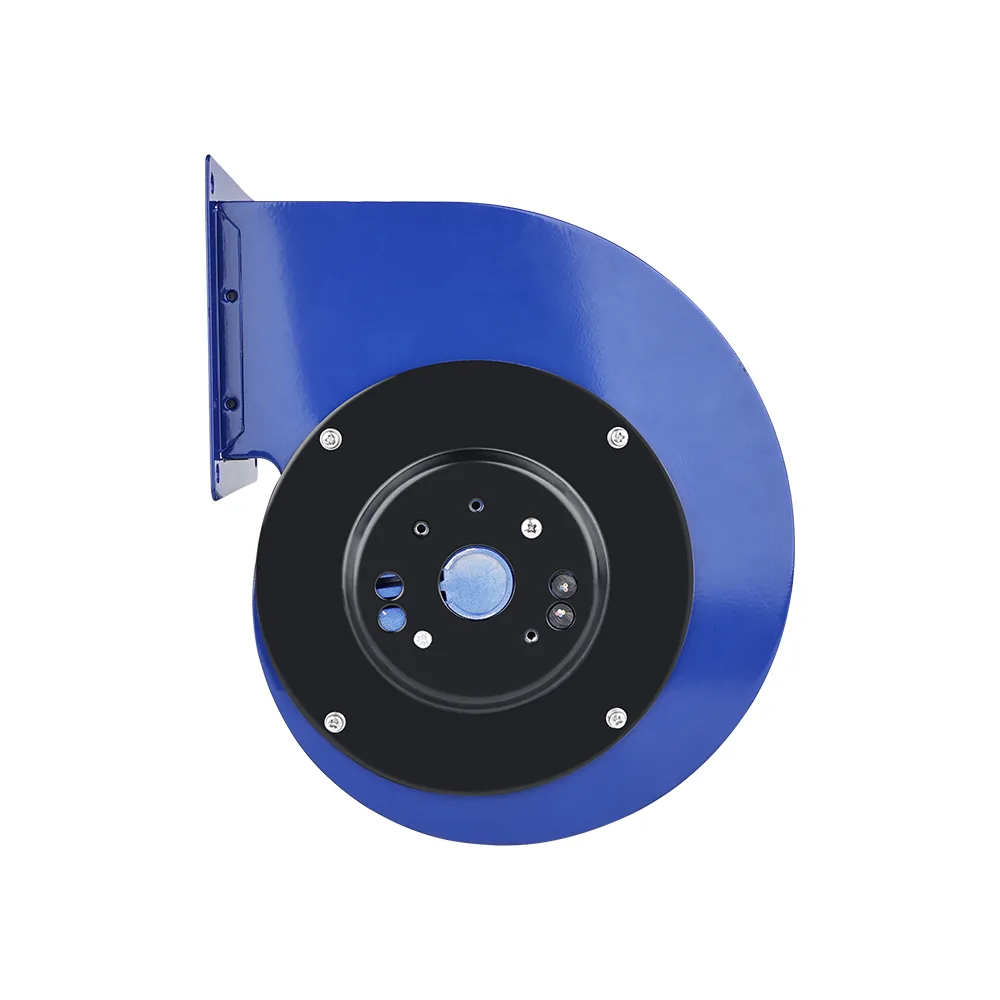
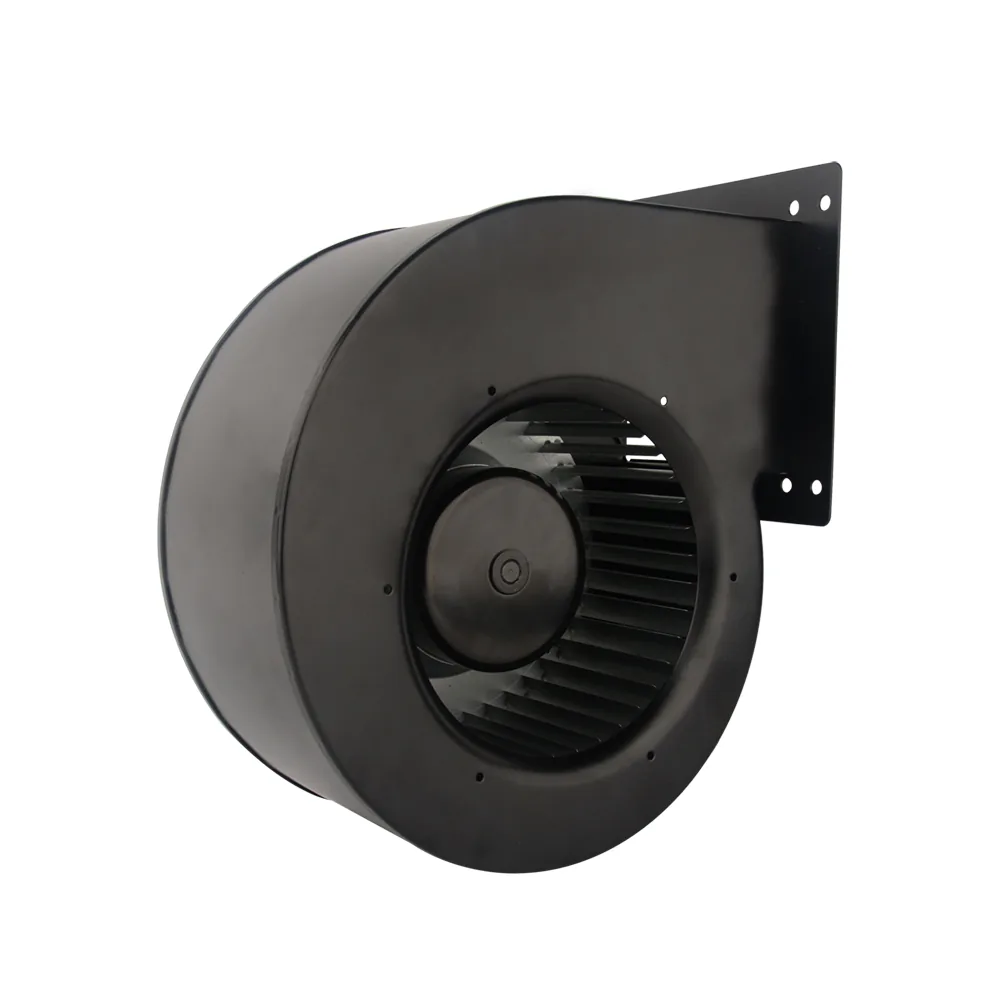
Three things make this family the default inside filtered equipment. The external-rotor motor lives inside the impeller, so a housed blower is barely deeper than its own wheel. The forward-curved wheel carries many shallow blades and makes its pressure at a low tip speed — the whole noise argument in one sentence. And the scroll housing gathers flow into a rectangular outlet a plenum can be gasketed to. Sizes for this work sit at the small end of our range:
| Build | Models | Wheel | Supply | Power | Speed | Max airflow | Max static pressure |
|---|---|---|---|---|---|---|---|
| EC, no housing (wheel and motor) | 8 | Ø108-160 mm | 230 VAC | 70-230 W | 1,800-3,340 rpm | 803 m³/h | 989 Pa |
| EC, single inlet with housing | 21 | Ø120-250 mm | 230 VAC | 42-510 W | 1,320-3,650 rpm | 1,957 m³/h | 989 Pa |
| DC, single inlet with housing | 28 | Ø120-180 mm | 24 / 48 / 310 VDC | 48-220 W | 1,250-2,550 rpm | 762 m³/h | 773 Pa |
| DC, two inlets with housing | 16 | Ø133-197 mm | 24 and 310 VDC | 80-185 W | 750-1,780 rpm | 1,236 m³/h | 597 Pa |
Those are family limits, not operating points. Two released datasheets: LWFD3G120-072SM-01 runs on 24 VDC over a 16-28 V window at 2,400 rpm, 3.95 A, 95 W, up to 360 m³/h free-blowing and 340 Pa at shut-off, PA66 wheel, 2.5 kg. LWFE3G146-092DS-02 is its mains equivalent: 230 V, 0.8 A, 115 W at 1,450 rpm, about 4.5 kg, up to 1,009 m³/h. Full ranges are on the EC centrifugal blowers and DC brushless blowers pages; P-Q curves and 3D files on our selection site. Air performance is tested to the AMCA 210 method.
Noise at the duty point, and what a dB(A) figure means in a room
A catalogue sound figure is one measurement at one condition, usually top speed on a bench; ours come from a semi-anechoic room, calibration report SSD202500326. The 146 mm mains blower above is quoted at 61 dB(A) at 1,450 rpm, the 24 V DC 120 mm unit at 65 dB(A) at 2,400 rpm, a 250 mm two-inlet model at 75 dB(A) at 960 rpm. None of those is what a user hears on a bedside table.
Three consequences. Sound follows tip speed hard, so the way to quieten a purifier is a bigger wheel turning slower at the same duty; we push builders one size up far more often than down. The cabinet is part of the acoustic design — bolt a blower to an unbraced panel and it will radiate through it. And ask for the level at your duty point, not the catalogue maximum: night-mode figures decide this market, and they come from running at 40-60% speed, where you can expect about 30% lower consumption at part load, confirmed against the load profile.
Airflow, static pressure, voltage and control mode are enough for a first answer.
Speed control: 0-10 V, PWM, tacho feedback and constant flow
Tell us the control mode before the drawing is frozen: it decides the drive, the lead-out and the wire count.
- 0-10 V analogue is standard on both housed ranges. On the EC 146 datasheet the window is 1 to 9.5 VDC and the motor drops to standby below 1 V, giving your board a clean off without a relay; the DC 120 sheet is similar, standby below 0.9 V.
- PWM. The EC drive we checked takes 1-10 kHz at 10-12 V amplitude over a 30-70% duty band; the DC sheet specifies 5 kHz. Limits differ by drive, so send the signal your controller produces.
- Tacho (FG) output is an open-collector pulse needing an external pull-up. Pulses per revolution are drive-specific: 1 on the 092-rotor unit we checked, 12 on a 138-rotor model. Confirm it for your model.
- RS485 exists on the 102, 138 and 188 rotor sizes only, which makes bus control a size decision before a protocol one.
On constant flow, be precise about where the intelligence lives: our standard drives hold speed, not flow. Holding airflow as the HEPA loads means closing a loop in your own controller — watching tacho and drive current together and lifting the setpoint as resistance rises, which also earns an honest filter-change alarm instead of a timer. If that logic has to live in the fan, say so at enquiry: it is drive firmware, frozen on the approved drawing.
Mounting, balance and vibration
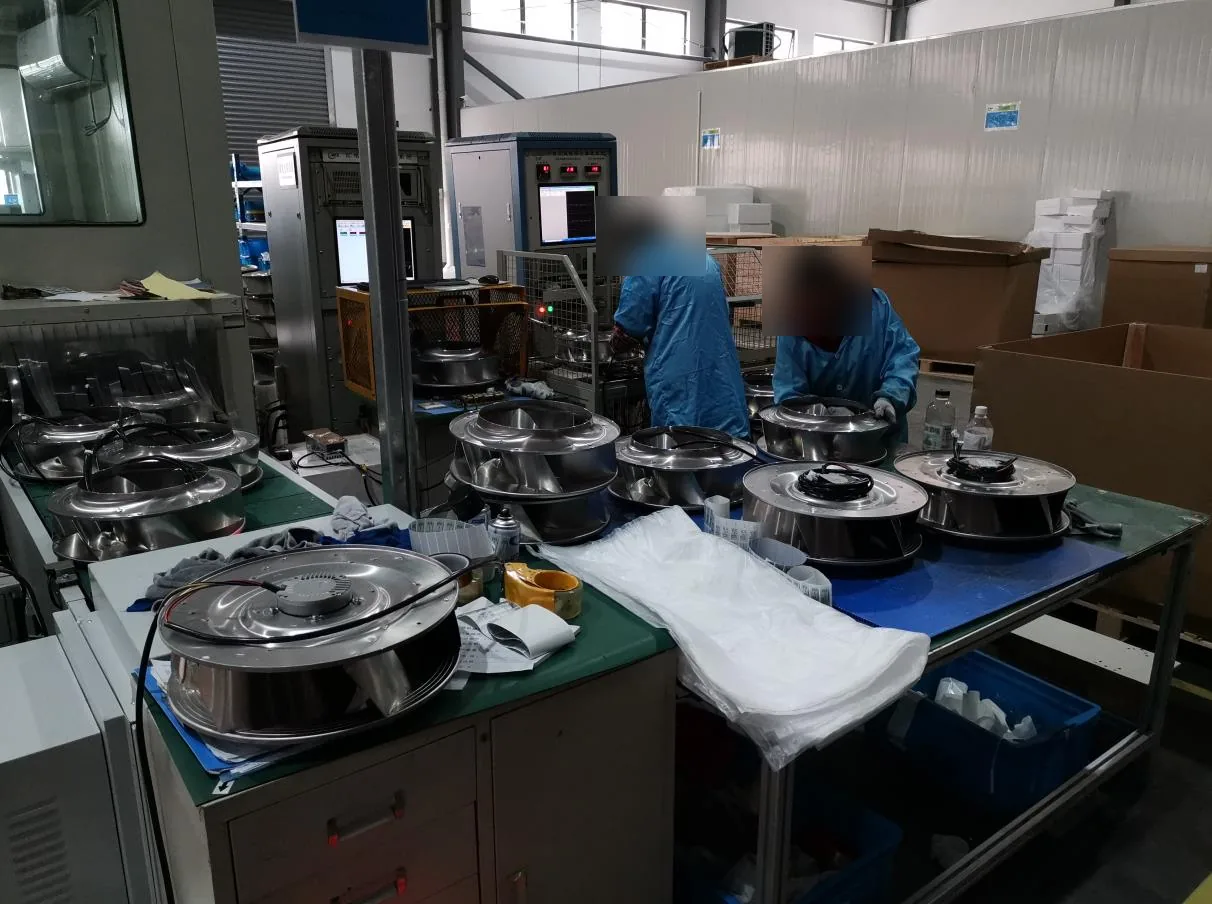
A purifier is a quiet product in a quiet room, so vibration that would be invisible in an air handling unit becomes the complaint. Catalogue forward-curved assemblies are balanced to G6.3 per JB/T 9101 and vibration-tested by the method of JB/T 8689; housed models are released for horizontal or vertical installation, and the attitude belongs on the drawing because it changes bearing loading and life. Bearings are maintenance-free deep-groove ball, catalogue life 20,000 hours L10 at 40 °C on some models and 40,000 on others — always read the temperature attached to the figure.
On your side: isolate with grommets or a moulded cradle rather than bolting steel to sheet, keep the inlet ring clear by a wheel width, and gasket the housing-to-plenum joint so filtered air cannot leak past the pack. Outlet orientation, bracket pattern and lead-out length change on a LONGWELL drawing.
The electrical safety points an appliance maker has to pass
A blower does not certify your appliance, but it makes the file easy or hard.
- Insulation and ingress. Class B or F by model, catalogue IP44 to IP54. These are design ratings on the approved datasheet; we hold no third-party IP certificate.
- Thermal protection. AC forward-curved motors carry a thermal protector, released window 150-160 °C to open, reset 100-130 °C. On EC and DC drives it is electronic: locked-rotor, over-temperature and over-current protection.
- End-of-line testing. Every unit passes earth continuity, dielectric withstand, insulation resistance and a running test before boxing.
- Material grades. Moulded housings and wheels are specified to a UL94 V-0 grade where the drawing calls for it. That is a material grade and nothing more; we never call it a listing.
- Certificate scope, stated exactly. ISO 9001 BMCQ0222448M, ISO 14001 BMCE0222279M and ISO 45001 BMCS0222232M run to 8 December 2028. Our CE certificates — LVD KB2207084L01, EMC KB2207085E01, RoHS KB2207086R01 — cover the AC forward-curved LWFA108-450 models only. ETL Recognized Component control number 5022563 covers part of the EC and DC range inside that report's model rule and power ceilings: 600 W at 48 V, 500 W at 24 V, 200 W at 12 V DC, around 1,100 W on the EC side. Ask in writing whether your model is inside those scopes. More on the quality and certifications page.
Who engineers it, who builds it
LONGWELL is Ningbo Longwell Electric Technology Co., Ltd., Yuyao, Ningbo, founded in 1990 and exporting to more than 30 countries. On this range we engineer and specify: blowers are built to LONGWELL drawings in qualified partner plants and inspected to LONGWELL standards before shipping under our label. In our own plant we run the motor winding line — automatic winding, coil insertion, inter-turn insulation testing and argon-arc welding of lead wires, audited in the 2021 ETL factory audit — and our own cross-flow fan production. Samples of catalogue models move in 1-3 days, production in 15-30 days, warranty 12 months; the route from duty point to frozen drawing is at our OEM process.
Send the airflow you need at the loaded filter, the clean and end-of-life resistance, the supply and the control signal, and we will come back with two or three candidate models and the curves to check them against. Talk to our engineering team.
Questions buyers ask
How do I size an air purifier blower when the filter resistance keeps changing?
Select at the loaded condition, not the clean one. Give us the airflow you must still deliver at the cabinet outlet, the clean-pack resistance at that airflow, and the end-of-life resistance you will allow before the change alarm - many appliance builds allow roughly twice the clean figure. We pick the model that meets the dirty point, then check that the clean point is not so far right on the curve that the unit is loud and inefficient on day one. A speed-controlled EC or DC drive lets you simply run slower while the filter is new.
EC or DC for a purifier - which should I specify?
It follows the supply, not preference. If the cabinet has a mains inlet and no separate power supply, an EC forward-curved blower with the drive built into the motor is the shorter bill of materials: 230 V in, 0-10 V or PWM speed in. If the product already has a 24 or 48 V rail - battery, portable, or a low-voltage appliance platform - a DC brushless blower is usually the cheaper and simpler answer. Both take the same speed signals and both give you part-load turn-down; the ranges are on the EC and DC pages.
Can your blowers hold constant airflow as the HEPA loads?
Our standard drives hold speed, not flow. Constant flow is closed in your controller: read the tacho (FG) output and the drive current, and lift the speed setpoint as resistance rises. That loop also gives you a genuine filter-change alarm instead of a run-hours timer. If the logic has to live inside the fan, raise it at enquiry stage - it is a drive firmware specification that gets agreed and frozen on the approved drawing, not something to assume from a catalogue line.
What does the dB(A) figure in your catalogue actually tell me about my product?
It is one number at one condition, usually maximum speed, measured in a semi-anechoic room (chamber calibration report SSD202500326). Your finished unit will differ because of the cabinet, the mounting, the outlet geometry and the room. Use catalogue figures to rank models, then ask us for the level at your duty point and speed. Practically, noise follows tip speed: a larger wheel turning slower at the same airflow and pressure is the reliable way to get a quieter purifier.
Are your blowers certified so I can use them in a domestic appliance?
State the scope precisely in your file. Our CE certificates - LVD KB2207084L01, EMC KB2207085E01, RoHS KB2207086R01 - cover the AC forward-curved LWFA108-450 models only. ETL Recognized Component control number 5022563 covers part of the EC and DC range within that report's model rule and power ceilings (600 W at 48 V, 500 W at 24 V, 200 W at 12 V on the DC side, around 1,100 W on the EC side). Management systems are ISO 9001 BMCQ0222448M, ISO 14001 BMCE0222279M and ISO 45001 BMCS0222232M to 8 December 2028. Ask us in writing whether your exact model sits inside a given scope and we will answer in writing; the blower does not certify your appliance.
What do you need from me to quote, and how quickly can I get a sample?
Airflow at the loaded filter, clean and end-of-life resistance, supply voltage, control mode, the space envelope and outlet orientation, plus the noise target and the standard your appliance is assessed against. With that we come back with two or three candidate models and their curves. Samples of catalogue models move in 1-3 days, production runs in 15-30 days, and the warranty is 12 months. Changes to outlet orientation, bracket pattern and lead-out are handled on a LONGWELL drawing before the model is frozen.
Where to go next
Blowers for ERV, HRV and Fresh-Air Units
Blowers for ERV, HRV and fresh-air units: EC and DC forward-curved data, supply and extract balance, condensation limits, and how an OEM specifies a pair.
Read the pageCentrifugal Air Blowers – Scroll and Volute Blower Range
LONGWELL scroll (volute) centrifugal air blowers: AC, EC, DC and gas lines, 77–355 mm, to 8,799 m³/h and 4,100 Pa. Compare the five lines.
Read the pageBlower Factory and OEM Manufacturing Capability
What LONGWELL builds in its own Yuyao plant, what partner plants build to our drawings, and the drawing, balancing and test controls an auditor can check.
Read the pageQuality and Certifications
Every certificate we hold, with numbers and scope: ISO 9001/14001/45001, KTS CE for LWFA108-450, ETL Recognized Component 5022563, AMCA 210 method testing.
Read the pageSend the duty point, get the model
Airflow, static pressure, voltage and control mode are enough to start — a drawing is better. An engineer answers, usually within one working day (GMT+8). Samples of catalogue models ship in 1–3 days.