
Buyer guide
Types of Blower Impeller: Wheel Forms, Blade Geometry and Balancing
The wheel decides what a blower can do. The motor sets the speed and the housing collects the air, but blade form, blade count and blade width fix the pressure curve, the slope of the power curve and most of the noise. This page covers the impeller types an equipment designer chooses between, using figures from our own wheel tables and specification sheets. If you already know the wheel you want, the ordering rules and drawing checklist are on blower wheels and impellers.
The five wheel families
Forward-curved multi-vane, the squirrel cage
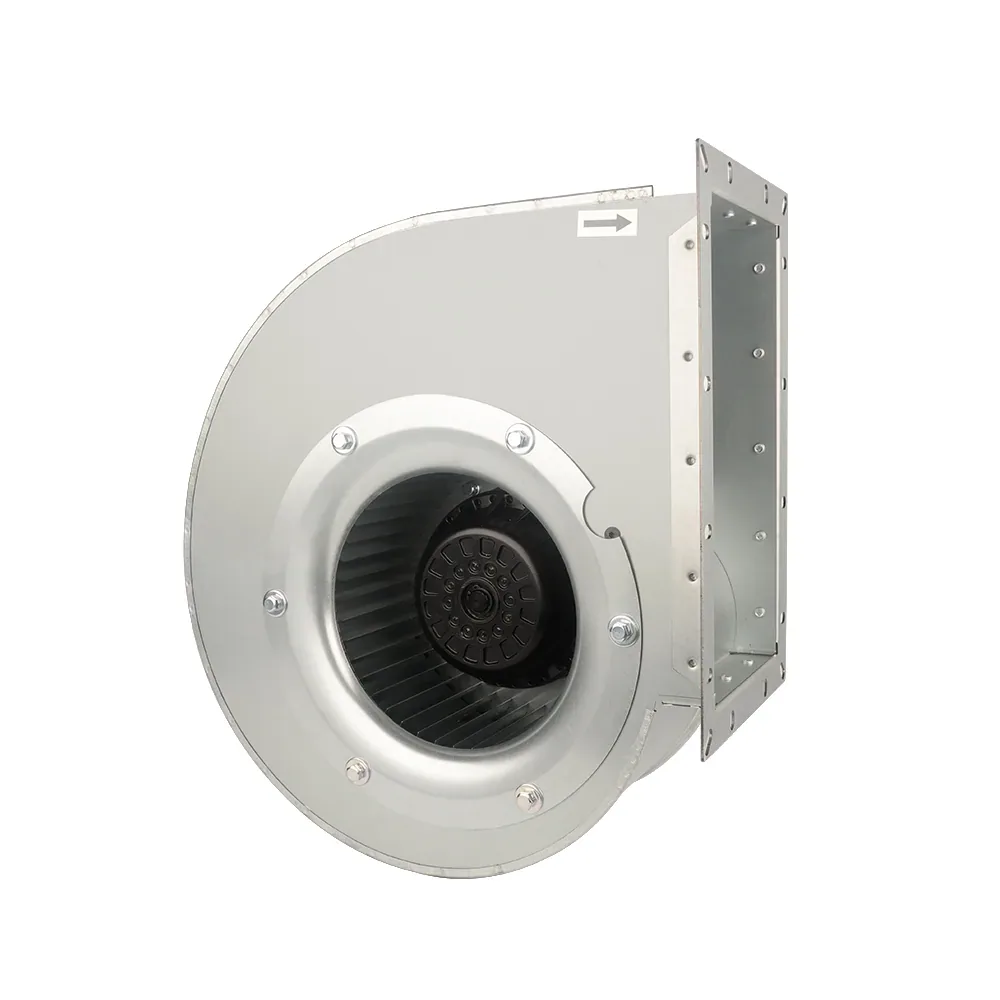
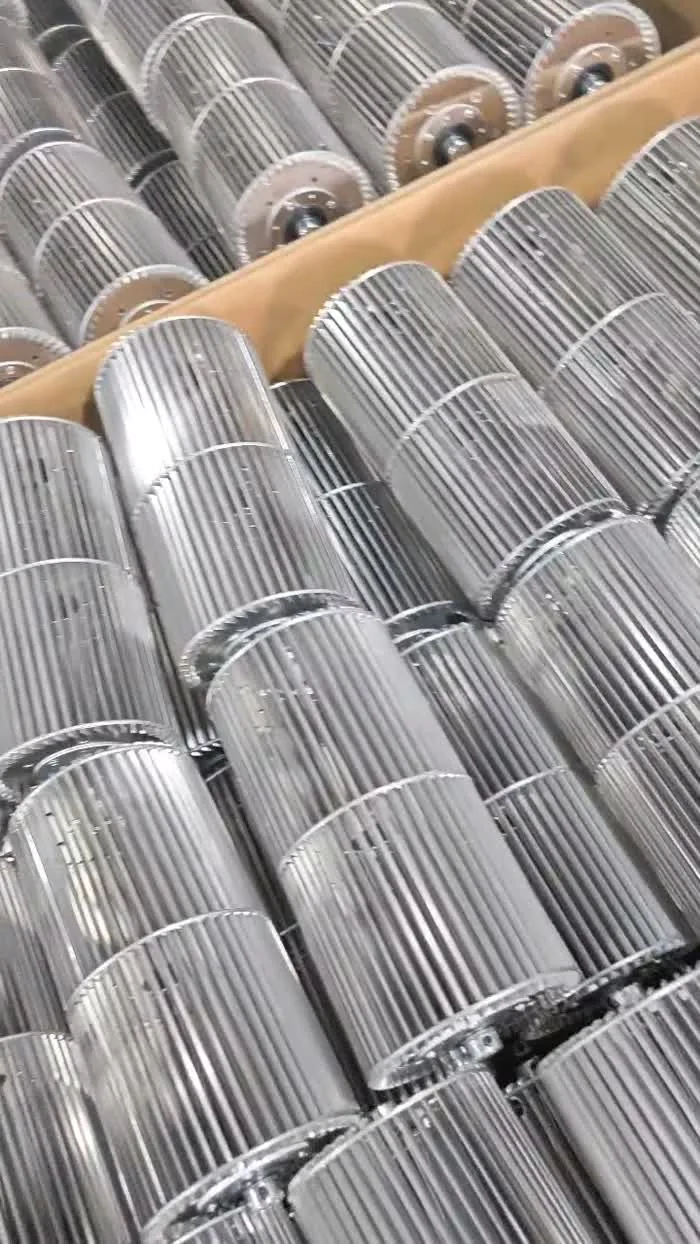
Many shallow blades curved toward the direction of rotation, on a narrow rim between a backplate and an end ring. It moves a large volume for its diameter at a low tip speed, so the assembly stays compact and slow-running. Our galvanised forward-curved wheels are tabulated at 97, 108, 120, 133, 140, 160 and 180 mm; the motorised assemblies run from 108 to 500 mm. It always needs a scroll housing to turn velocity into static pressure.
Backward-curved and backward-inclined
Few, deep blades curved away from rotation. Our aluminium backward wheel drawing carries eight blades, in ten outer-rotor sizes from 250 to 710 mm with matched inlet rings. For the same pressure it needs a higher tip speed, so it is larger or faster, but it holds efficiency across a wide duty range and its power curve peaks then falls, so the motor will not overload if system resistance drops. It also works without a scroll, which is why plenum arrangements use it.
Radial and paddle
Straight blades on a single disc, sometimes only four: our smallest radial component is a 56 mm wheel with four blades, and the 85, 97 and 200 mm sizes carry eight. Low flow, high pressure per diameter, tolerant of dust and fibres, and the least efficient and loudest of the three. It is the geometry behind combustion air: our EC gas combustion blowers run to about 87 m³/h free-blowing and about 2,350 Pa at shut-off from a 60 W wheel turning 10,000 rpm — opposite ends of one curve — and to about 220 m³/h and 4,100 Pa at 210 W on the largest build.
Mixed flow and axial, for contrast
An axial impeller has three to seven blades on a hub and pushes air along the shaft axis; our plastic axial range runs from about 120 to 265 mm, weighing 38 to 175 g. Plenty of air for very little power and almost no pressure, so it fails the moment a coil, a filter or a duct run sits in front of it. Mixed flow sits between: in-line footprint, more pressure than axial, less than a scroll blower.
| Wheel type | Blades | Flow vs pressure | Power curve | Typical duty |
|---|---|---|---|---|
| Forward-curved | Dozens, shallow | High flow, moderate pressure, small diameter | Rises with flow, can overload | Fan coils, air handlers, cabinets |
| Backward-curved | About eight, deep | Moderate flow, high pressure, larger or faster | Peaks then falls, non-overloading | Plenum fans, variable duty |
| Radial / paddle | Four to eight, straight | Low flow, very high pressure | Rises steadily | Combustion air, dust-laden air |
| Cross-flow | 24 to 35 per drum | Wide even curtain, very low pressure | Flat | Air curtains, split units, heaters |
| Axial | Three to seven | Very high flow, near-zero pressure | Rises to free delivery | Condensers, open-air movement |
Blade count and blade width
Blade count is not a quality signal, it is a consequence of the blade form. A deep backward blade does its work in one long passage, so eight are enough; a shallow forward blade turns the air through a small angle, so dozens are needed to fill the same annulus. More blades raises the blade-pass frequency, easier to absorb than the low whine of a small blade count, but adds surface, friction loss and lost efficiency.
Blade width is the parameter buyers most often forget, and the one we vary most. At one diameter, our 140 mm forward-curved wheel is tabulated in eight widths from 32 to 79 mm, and the 180 mm wheel in seven widths from 32 to 92 mm. Widening the wheel at constant diameter and speed roughly scales volume flow while leaving pressure rise largely alone, because pressure follows tip speed. Short of air, a wider wheel is usually cheaper than a bigger one; short of pressure, it is no answer at all. Cross-flow drums work the same way along their length: 50 to 180 mm diameter, lengths to 1,200 mm.
Airflow, static pressure, voltage and control mode are enough for a first answer.
Wheel materials
Galvanised sheet steel is the default for forward-curved wheels and scroll housings, and it is what our forward-curved specification sheets state: blades inserted into a centre plate and an end ring and closed with riveting grippers. Cheapest route, highest stress capacity, heaviest.
Aluminium is used mainly for backward-curved wheels, where tip speed is high and rotating mass costs power. Reinforced plastic, typically ABS with glass fibre or reinforced AS, ABS and PP, is injection moulded from roughly 65 mm upward; a metal bush is insert-moulded into the hub so the bore is still metal, and double-inlet plastic wheels are made as two halves and joined. Plastic is quiet, light, corrosion-proof and dimensionally repeatable, but it needs a mould, so it only pays back over volume. Stainless, including 316L, is a project route for wash-down duty.
Balancing grades: what G6.3 and G2.5 actually mean
A balance grade is not a tolerance on the part; it is a limit on residual unbalance scaled by speed. The grade number is permissible eccentricity multiplied by angular velocity, in mm/s, so the same grade gets physically tighter the faster the wheel turns. Take the 960 rpm printed on one of our 250 mm EC forward-curved sheets: G6.3 allows the mass centre to sit about 63 micrometres off the axis, G2.5 about 25. Put G6.3 on a 2,550 rpm wheel and it is already down to about 24 micrometres.
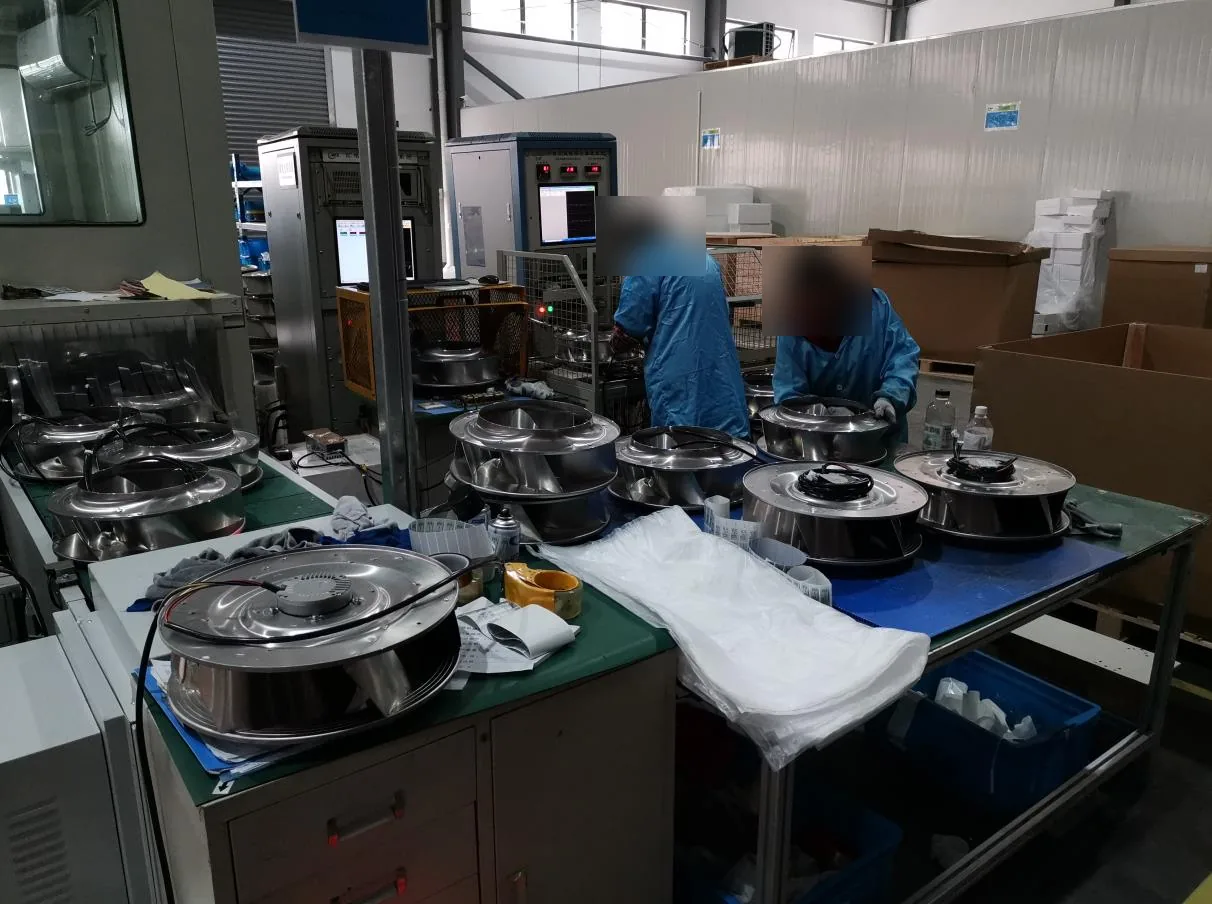
Our catalogue forward-curved assemblies are specified to G6.3, the grade printed on the specification sheet alongside the vibration test method. The direct-driven commercial family is held to an internal wheel-balancing standard of G2.5 or better. Going from G6.3 to G2.5 is not a free line on a drawing: more correction mass, more rework on the balancing machine, a tighter incoming tolerance on the wheel. Ask for it when the fan sits on something a person touches or on a structure that will amplify a small excitation, not as a default. On project wheels an absolute residual unbalance at a stated speed is often the clearer instruction.
Hub, bore and direction of rotation
Two wheels can share a diameter, a width and a blade form and still not interchange, because the hub differs. Our metal wheel tables carry two hub schemes. An inner-rotor wheel takes a plain shaft bore at 5.5, 6, 8 or 10 mm, usually with a set screw or keyway. An outer-rotor wheel has no bore at all: it registers on the motor rotor, and the table gives the rotor size instead, 72 or 92 mm on the small forward-curved wheels. Plastic wheels list an axle hole from 3 to 10 mm plus a mounting hole pattern, and many are supplied for bottom-insert motor mounting.
Direction of rotation must be stated with the viewpoint attached, because clockwise means nothing on its own. Our direct-driven convention looks from the sleeve side: clockwise is R, counter-clockwise is L, and the discharge is then set at 0, 90, 180 or 270 degrees. Cross-flow drums are tabulated counter-clockwise seen from the shaft end. Most forward-curved sizes come in both hands; some backward-curved sizes are clockwise only. A wheel in the wrong hand is not repairable, so say which end you are looking from.
Turning a wheel choice into a part
The practical question is then whether an existing assembly already covers the duty. Model-level curves and CAD are on select.longwellfans.com, worth checking before paying for a wheel. Air performance on our finished products is tested to the AMCA 210 method and sound is measured in octave bands. Where the duty varies, an EC drive usually saves more than a wheel change: about 30% lower consumption at part load, confirmed against the load profile. See EC centrifugal blowers and forward curved squirrel cage blowers.
On who builds what, we would rather be plain. Our cross-flow line runs in our own plant in Yuyao on our own drawings, moulds and impeller tooling, and our motor winding line is in house. The other wheel and blower families are engineered and specified by LONGWELL, built to LONGWELL drawings in qualified partner plants and inspected to LONGWELL standards. Certificate scopes are on quality and certifications. Samples of catalogue models ship in 1 to 3 days, production 15 to 30 days, warranty 12 months.
Tell us the duty point and the space you have, and we will come back with the wheel type, the diameter and width, and whether a catalogue assembly already covers it.
Questions buyers ask
Forward-curved or backward-curved: which should I put in my unit?
Start from the space and the duty. If the cabinet is tight, the pressure is moderate and the fan runs at or near one design point, forward-curved gives the most air for the smallest diameter and the lowest speed, which is why fan coils and air handlers use it. If the duty varies, the pressure is high, or you cannot risk the motor overloading when a filter is clean or a damper opens, go backward-curved: its power curve peaks and falls rather than climbing, and it holds efficiency across the range. Backward-curved also works without a scroll, so it suits plenum arrangements.
Does a wider wheel at the same diameter simply give more air?
Broadly yes, and that is why we tabulate so many widths at one diameter, for example eight widths from 32 to 79 mm on the 140 mm forward-curved wheel. At constant diameter and speed, widening the wheel scales the volume flow while the pressure rise stays roughly where it was, because pressure follows tip speed. It also raises the power draw, so check the motor. What a wider wheel will not do is give you more static pressure: for that you need a larger diameter, a higher speed or a different blade form.
What is the practical difference between G6.3 and G2.5?
The grade is permissible eccentricity multiplied by angular velocity, in mm/s, so it tightens as speed rises. At 960 rpm, G6.3 allows the mass centre about 63 micrometres off the axis and G2.5 about 25; at 2,550 rpm, G6.3 is already about 24. Our catalogue forward-curved assemblies are specified to G6.3, which is the grade printed on the specification sheet. The direct-driven commercial family is held to an internal standard of G2.5 or better. Calling for G2.5 means more correction mass, more machine time and a tighter incoming wheel tolerance, so ask for it where vibration actually matters rather than by default.
How do I state direction of rotation so it cannot be misread?
Always attach the viewpoint. Clockwise on its own is meaningless, because the same wheel is clockwise from one end and counter-clockwise from the other. Our direct-driven convention looks from the sleeve side: R is clockwise, L is counter-clockwise, and discharge is then set at 0, 90, 180 or 270 degrees. Cross-flow drums are tabulated counter-clockwise seen from the shaft end. Most forward-curved sizes are available in both hands, some backward-curved sizes in one only. A wheel supplied in the wrong hand cannot be corrected, so write the viewpoint on the drawing.
When is a plastic impeller worth it instead of galvanised steel?
When the volume justifies a mould. Injection-moulded reinforced plastic, usually ABS with glass fibre or reinforced AS, ABS and PP, is light, quiet, corrosion-proof and dimensionally repeatable part to part, with a metal bush insert-moulded into the hub so the bore is still metal. Against that, the tooling is the real cost and the temperature and stress limits are lower than steel. Galvanised sheet steel stays the default for forward-curved wheels and scroll housings, aluminium for backward-curved wheels where rotating mass costs power, and stainless including 316L for wash-down duty on project orders.
Do you publish a performance curve for each wheel?
We publish curves for finished blowers, not for bare wheels, because a wheel has no curve until you fix the housing, the inlet cone and the speed. Model-level curves and CAD for the assemblies are on select.longwellfans.com, and air performance is tested to the AMCA 210 method with sound measured in octave bands. If you are evaluating a loose wheel for an existing housing, send the housing drawing with the wheel requirement; the inlet-cone overlap and the cut-off clearance change the result more than most people expect.
More in this section
China Blower Supplier Audit: A Checklist from Inside the Factory
The documents to demand, how to verify a certificate number, what to look at on the floor, and the questions that expose a trading company.
Read the pageHow to Specify a Centrifugal Blower
What to tell a blower supplier to get the right model first time: duty point, voltage, control mode, envelope, noise, IP, life and volume.
Read the pageWhat drives the cost of an OEM centrifugal blower
No prices - what actually moves a centrifugal blower quotation: wheel size and material, motor type, tooling, volume, certification and freight.
Read the pageSend the duty point, get the model
Airflow, static pressure, voltage and control mode are enough to start — a drawing is better. An engineer answers, usually within one working day (GMT+8). Samples of catalogue models ship in 1–3 days.