
Home/Blowers
Centrifugal blower range
Centrifugal Air Blowers – Scroll and Volute Blower Range
A centrifugal air blower throws air off the tips of a spinning wheel. In the scroll type on this page a forward-curved multi-blade wheel turns inside a volute housing: air enters axially through one or two inlets, and the widening scroll converts blade velocity into static pressure at a rectangular outlet. That is why a centrifugal type blower still delivers air through a filter, a coil or several metres of duct, where an axial fan stalls.
Every forward-curved line below is a direct drive centrifugal blower: the wheel sits straight on an external-rotor motor turning inside it, so there is no belt, no pulley and no bearing pedestal — a centrifugal blower with motor as one balanced assembly. The gas and combustion blowers are direct drive too, on their own motor types.
Five lines, one family, and how to choose
The lines share the volute principle and differ in inlets, motor and duty. Narrow it down here, then open the line page for sizes and curves.
| Line | Supply | Impeller Ø | Airflow | Static pressure | Typical application | Page |
|---|---|---|---|---|---|---|
| Forward-curved, single inlet, AC | 230 / 380 V AC | 120–315 mm | 206–5,150 m³/h | 201–695 Pa | Fan coils, heaters, cabinets | Single inlet blowers |
| Forward-curved, double inlet, AC | 230 V AC, 1.5–6 µF | 120–300 mm | 278–5,227 m³/h | 134–639 Pa | AHU sections, ERV, hoods, air curtains | Forward-curved blowers |
| EC volute, single inlet | Per model datasheet; 0–10 V or PWM | 120–250 mm | 268–1,957 m³/h | 191–989 Pa | Air purifiers, FFU, compact ducted units | EC centrifugal blowers |
| EC volute, double inlet | 230 / 380 V, 0–10 V or PWM | 120–355 mm | 433–8,799 m³/h | 247–1,102 Pa | AHU, ERV, high-airflow ducted equipment | Same page |
| DC brushless, single inlet | 24 / 48 / 310 V DC | 120–180 mm | 319–762 m³/h | 189–773 Pa | Low-voltage and battery equipment, medical | DC brushless blowers |
| DC brushless, double inlet | 24 and 310 V DC | 133–197 mm | 680–1,236 m³/h | 294–597 Pa | Cabinet cooling, vehicle and off-grid units | Same page |
| Gas / combustion, EC and DC | 115 / 230 V AC with 12 / 24 V PWM; DC 12 / 24 V | 77–150 mm blade | 87–260 m³/h | 556–4,100 Pa | Condensing and wall-hung boilers, water heaters, premix burners | Gas & combustion blowers |
| Gas / combustion, AC | 220–240 V, 50 Hz | 85–180 mm blade | 82–172 m³/h | 185–597 Pa | Pellet stoves, flue extraction, ovens | Same page |
Catalogue data from the 2026 LONGWELL forward-curved and gas blower catalogues. The airflow and pressure columns are the two ends of each family’s range, never a duty point: the two maxima sit at opposite ends of one curve. We confirm the line against your duty point — airflow, static pressure, voltage, control mode — before quoting it. Model-level P-Q curves and CAD: select.longwellfans.com.
AC forward-curved lines
The volume families: 24 single-inlet models at Ø120–315 and 54–2,200 W, 33 double-inlet models at Ø120–300 and 60–1,380 W on a 1.5–6 µF run capacitor. Single inlet is the shorter package, and the usual choice under roughly 1,500 m³/h; two inlets feed one wide wheel, so the same diameter moves far more air at moderate pressure. Which one fits your cabinet is worked through on the single inlet page.
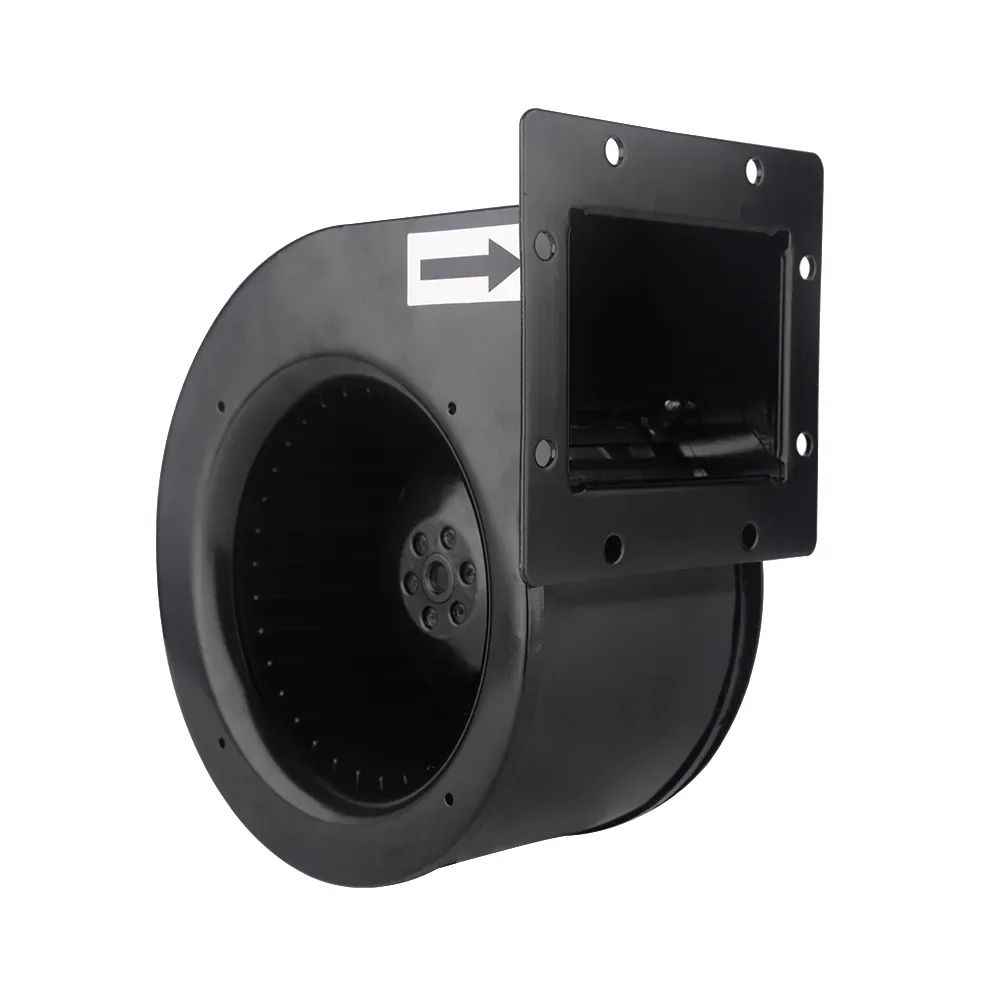
EC volute blowers
Same volute and wheel, driven by an electronically commutated external-rotor motor with a 0–10 V or PWM input, so the blower is speed-controlled without an external drive. Twenty-one single-inlet models cover 42–510 W; 22 double-inlet models cover 70–2,400 W and reach 8,799 m³/h, about 5,180 CFM at standard air — the high-CFM end of this family, and why EC turns up in air handling units, not small cabinets.
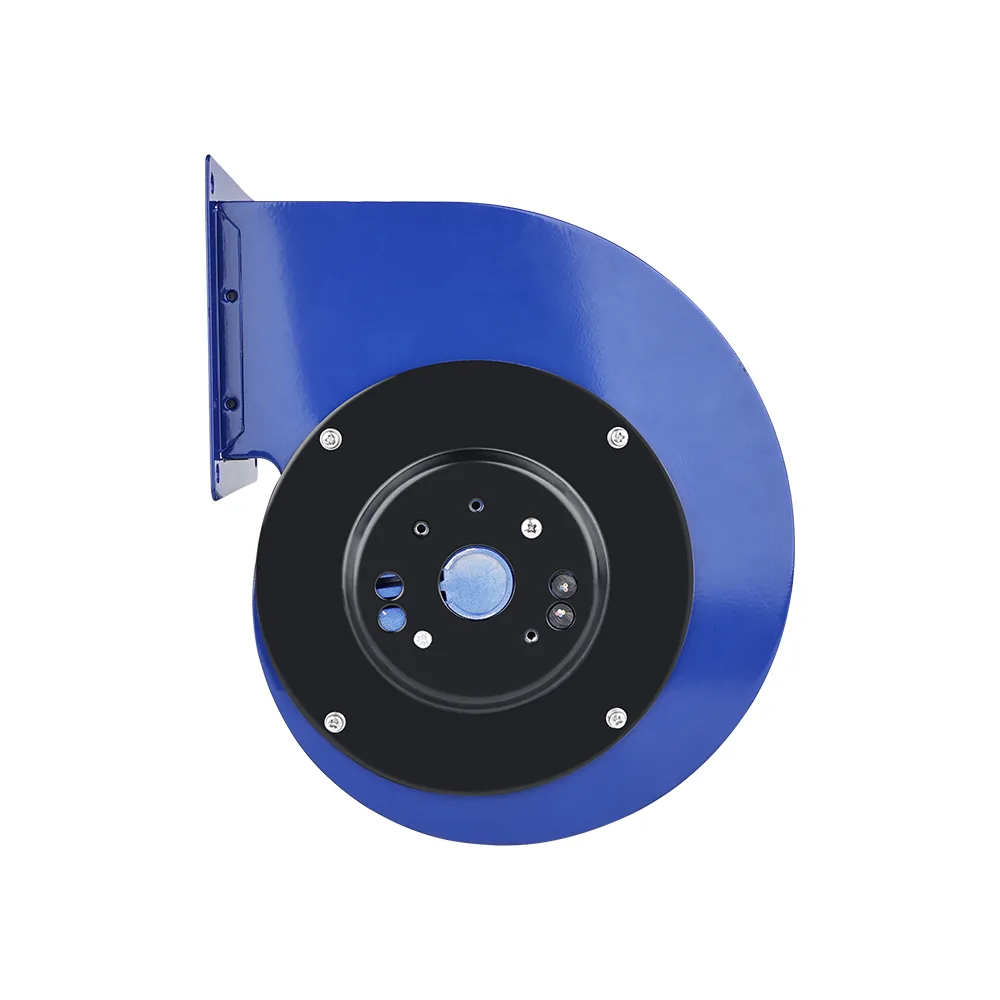
DC brushless blowers
What many buyers call a radial centrifugal blower: a compact volute blower on 24, 48 or 310 V DC with 0–10 V speed control. Twenty-eight single-inlet models cover 48–220 W, 16 double-inlet models 80–185 W. It is the answer when the equipment has no mains bus: battery packs, vehicles, medical trolleys, off-grid cabinets. Frames and voltages: DC brushless blowers.
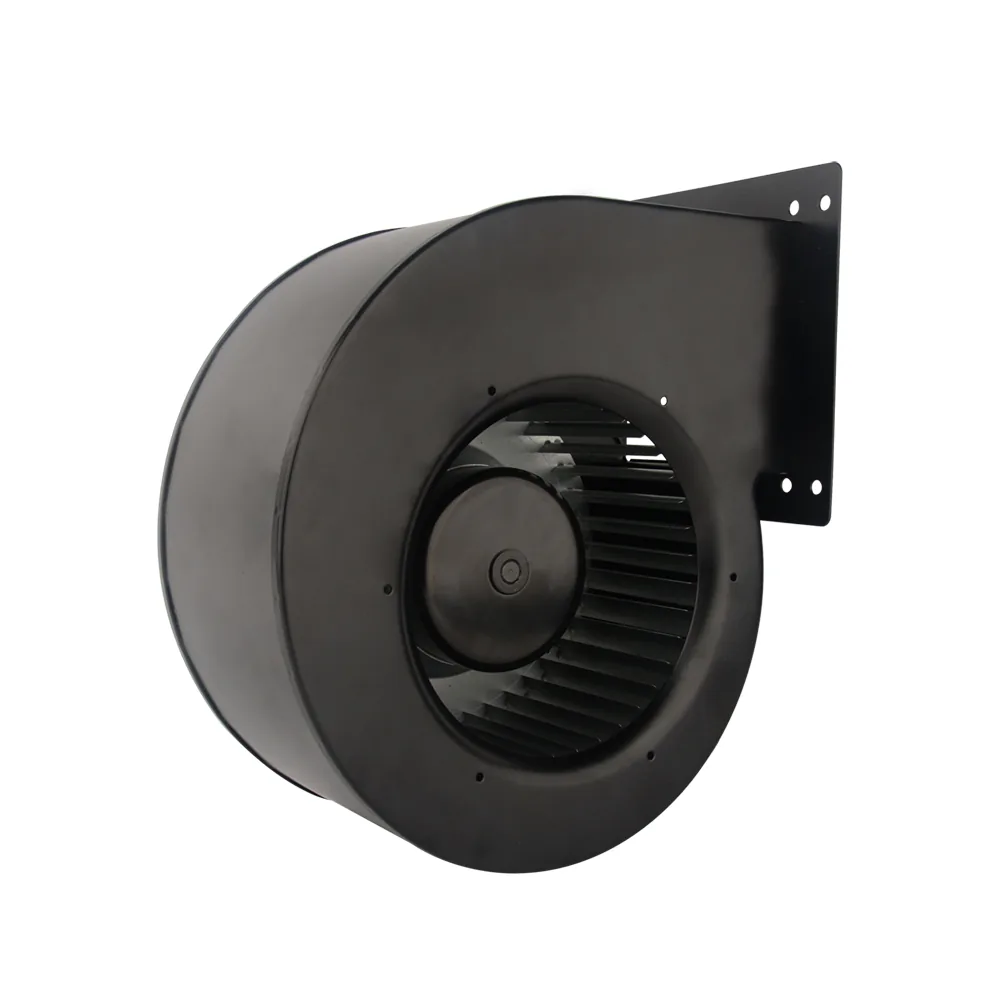
Gas and combustion blowers
A different problem: low airflow against very high pressure, in hot flue gas. The EC and DC range covers 77–150 mm blades at 40–300 W and reaches 4,100 Pa; the AC 085–180 series is a 30–75 W flue and stove range. Housings are die-cast aluminium, impellers anti-static plastic, and the DC gas catalogue states aluminised steel for flue gas at 180 °C continuous, 240 °C short term. Burner matching: gas and combustion blowers.
Airflow, static pressure, voltage and control mode are enough for a first answer.
AC, DC or EC
The centrifugal blower motor decides the control scheme, not the aerodynamics. An AC centrifugal blower is cheapest and is usually switched in two or three fixed speeds; the KTS CE certificates cover the AC forward-curved LWFA108–450 sizes only, so check the scope against your model. DC suits equipment with no mains bus: 24 and 48 V on a 0–10 V input, catalogue insulation mostly class B. EC gives continuous speed control and a tachometer (FG) output, so it holds a set airflow as the filter loads. If the blower spends most of its hours below full speed, an EC build pays back; at one fixed duty, an AC build usually does not need replacing.
Housing and impeller materials
Standard volutes are galvanised sheet steel with lock-formed seams; gas blowers use die-cast aluminium. A plastic centrifugal blower is available where weight, corrosion or moulded mounting features matter: the plastic impeller catalogue covers centrifugal wheels from LW65×110 to LW476×169.5 in ABS+GF or reinforced AS, ABS and PP, and plastic volutes are supplied on AC double-inlet frames. EC plastic housings are quoted on request. Housing-less builds, structure letter N, ship as motorised impellers — see blower wheels and impellers.
When a scroll blower is the wrong answer
Pick a scroll blower when air must be pushed into something — duct, filter, coil, burner — and the outlet direction is fixed. Pick a plug fan or a backward-curved impeller instead when the fan sits in a plenum and discharges all round, or when the motor must stay out of the airstream. Those ranges, and the belt-driven sizes, are a different family on our main fan site longwellfans.com.
Reading the model code
LWFE3G146-092DS-10 decodes left to right:
- LWF LONGWELL forward-curved (B = backward-curved); A / D / E = AC, DC or EC motor.
- 2E / 4E / 6E single-phase AC poles, 4D / 6D / 8D three-phase, 3G on DC and EC.
- 146 impeller Ø in mm; 17 standard frames from 108 to 500.
- 092 rotor size: 072, 092, 102, 138, 188, 218. RS485 is offered on the 102, 138 and 188 rotors only.
- D structure: N no housing, S single inlet, D double inlet, P with bracket. S voltage: T 380 V AC, S 230 V AC, U 115 V, L 12 V DC, M 24 V DC, H 48 V DC, Z 310 V DC.
Who builds these
LONGWELL is Ningbo Longwell Electric Technology Co., Ltd., Yuyao, Ningbo, founded 1990 and exporting to more than 30 countries. Cross-flow fans are made in our own Yuyao plant, and the motor winding line was audited during the 2021 ETL factory audit — see our plant. The five scroll lines here are our specification, our drawings and our inspection standard, built in qualified partner plants: one specification owner, one nameplate. What we make and what we source is set out in full on our centrifugal blower manufacturer page.
Can you build to my drawing?
Yes. LONGWELL owns the drawings for these families, so outlet angle, inlet ring, bracket, shaft, lead length, connector and nameplate change on existing tooling; new tooling is quoted when the volute or the wheel itself changes. The step-by-step is in the OEM process section. Send a 2D or 3D file through contact and we tell you which case you are in before you commit.
How fast is a sample, and what is the lead time?
Catalogue models ship as samples in 1 to 3 days. Production is 15 to 30 days depending on model and quantity, and the warranty is 12 months. Minimum order quantity depends on whether the build is a catalogue model or a tooled variant; tell us the annual volume and it comes back with the quotation.
Which certificates apply to these lines?
The KTS CE certificates cover the AC forward-curved LWFA108–450 range only; the 455–500 sizes are outside them, and so are the EC, DC and gas lines. Part of the EC and DC range is an ETL Recognized Component under Intertek control number 5022563; that report carries a model rule and a power ceiling, so we confirm coverage for your exact model in writing before quoting. Numbers, scopes and expiry dates: quality and certifications.
How is performance measured?
Air performance is tested to the AMCA 210 method; sound is measured in a semi-anechoic room with calibration report SSD202500326. Catalogue IP and insulation values are design ratings by family, IP54 at the ceiling; we hold no third-party IP certificate.
Do you supply the wheel or housing on its own?
Yes — motorised impellers, bare forward-curved wheels and empty volutes are quoted from the same drawings. Balance grade, hub bore and keyway are set on the drawing; our reference wheels are balanced to G6.3.
If you already know the line, go straight to its page. If not, tell us what the blower must deliver and the envelope it must fit, and we will say which of the five lines is right and which two are not. Ask for a selection with the drawing attached: you get the models that fit, their curves and a price, usually by the next working day.
Questions buyers ask
Can you build to my drawing?
Yes. LONGWELL owns the drawings for these families, so outlet angle, inlet ring, bracket, shaft, lead length, connector and nameplate change on existing tooling; new tooling is quoted when the volute or the wheel itself changes. The step-by-step is in the OEM process section on the home page. Send a 2D or 3D file through our contact page and we tell you which case you are in before you commit.
How fast is a sample, and what is the lead time?
Catalogue models ship as samples in 1 to 3 days. Production is 15 to 30 days depending on model and quantity, and the warranty is 12 months. Minimum order quantity depends on whether the build is a catalogue model or a tooled variant; tell us the annual volume and it comes back with the quotation.
Which certificates apply to these lines?
The KTS CE certificates cover the AC forward-curved LWFA108-450 range only; the 455-500 sizes are outside them, and so are the EC, DC and gas lines. Part of the EC and DC range is an ETL Recognized Component under Intertek control number 5022563; that report carries a model rule and a power ceiling, so we confirm coverage for your exact model in writing before quoting. Numbers, scopes and expiry dates are on the quality and certifications page.
How is performance measured?
Air performance is tested to the AMCA 210 method; sound is measured in a semi-anechoic room with calibration report SSD202500326. Catalogue IP and insulation values are design ratings by family, IP54 at the ceiling; we hold no third-party IP certificate.
Do you supply the wheel or housing on its own?
Yes - motorised impellers, bare forward-curved wheels and empty volutes are quoted from the same drawings. Balance grade, hub bore and keyway are set on the drawing; our reference wheels are balanced to G6.3.
Pages in this section
Combustion Blowers for Gas Boilers, Water Heaters and Premix Burners
AC, EC and DC combustion blowers for gas boilers, water heaters and premix burners: 82-260 m3/h, to 4,100 Pa, 30-300 W, built to LONGWELL drawings.
Read the pageDC Brushless Blowers: DC Blower Fan and BLDC Blower Manufacturer
DC blower fans 40-197 mm, 12/24/48 V and 310 VDC, PWM or 0-10 V, ball bearings. Built to LONGWELL drawings. Curves and CAD on our selection site.
Read the pageEC Centrifugal Blowers
LONGWELL LWFE3G EC centrifugal blowers: 51 models, 42-2400 W, to 8799 m3/h and 1102 Pa, 0-10 V, PWM and RS485 control. OEM supply, samples in 1-3 days.
Read the pageForward Curved Squirrel Cage Blowers — AC, EC and DC, Ø108–500 mm
AC, EC and DC squirrel cage blowers, Ø108–500 mm, to 9,064 m³/h. Catalogue data, model code, and CE and ETL scope stated plainly.
Read the pageSend the duty point, get the model
Airflow, static pressure, voltage and control mode are enough to start — a drawing is better. An engineer answers, usually within one working day (GMT+8). Samples of catalogue models ship in 1–3 days.