
Buyer guide
What drives the cost of an OEM centrifugal blower
Search for a centrifugal blower price and most of what comes back is a retail replacement part with a number on it. An OEM blower is quoted, not listed: the number is the sum of decisions about wheel size and material, motor type, housing, tooling, packing, certification scope and delivery.
So this page carries no prices and no ranges. It sets out what moves the number, so you can read two quotations side by side and see whether you are comparing the same product. When two suppliers are far apart on the same diameter, the gap is hiding somewhere in this list.
Wheel diameter and material
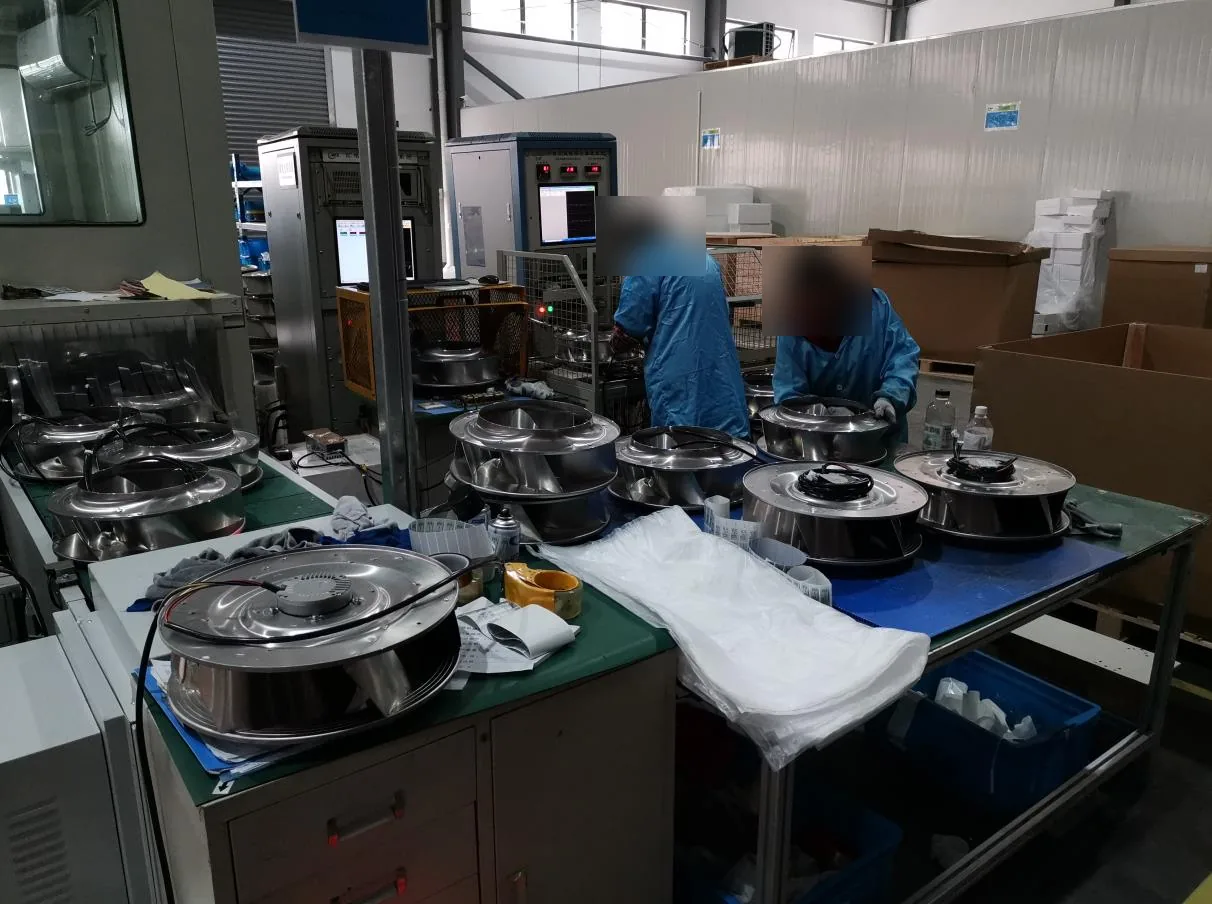
The impeller sets everything downstream. Our forward-curved catalogue runs Ø108 to Ø500 mm, each diameter on a defined external-rotor motor size — 072, 092, 102, 138, 188 or 218. A bigger wheel means more sheet metal, a larger motor, a larger carton and more shipping volume, in that order.
Material is the second lever. Standard wheels are galvanised steel or aluminium; reinforced plastic wheels are moulded in ABS+GF or reinforced AS, ABS and PP, covering LW65×110 to LW476×169.5. Special alloys are a different conversation: a stainless 316L wheel built to a customer drawing was specified at Ø230 mm with residual unbalance under 120 mg at 960 rpm, and both the alloy and the tighter balance show up in the quotation. Balance grade is a cost item in itself — our EC and DC data sheets call for G6.3 to JB/T 9101-1999, and a tighter grade is extra work on every piece.
Motor type: where the extra money goes
The motor is usually the largest single line, and the three families are not variations on one thing.
- Shaded pole. Simplest and cheapest to build, still the right answer at small sizes and fixed duty — our small AC gas blowers are single-phase two-pole shaded-pole machines from 11 W up. One speed, low efficiency, nothing to fail electronically.
- PSC (capacitor run). The mainstream AC blower motor: our AC double-inlet family runs on a 1.5–6 µF run capacitor with two or three fixed speeds off tapped windings. The capacitor, taps and wiring add cost over shaded pole; efficiency and controllability improve.
- BLDC / EC. Here the extra money is electronics, not metal: a drive board, commutation and sensing, a 0–10 V or PWM control input, an FG tacho output (12 pulses per revolution on LWFE3G250-138DS-02), locked-rotor and current-limit protection. That board is the difference, and it is what buys continuous speed control, a held airflow as the filter loads, and about 30% lower consumption at part load, confirmed against the load profile.
The test is duty cycle: a blower at one fixed operating point rarely justifies EC on energy alone, one that idles most of the year usually does, and the payback is a calculation on your load profile. Ranges are on the EC centrifugal blowers and forward-curved squirrel cage blower pages.
Housing material, finish and outlet
Standard volutes are galvanised sheet steel with lock-formed seams — cheap, stiff and well understood. Painted or plated finishes, a non-standard inlet ring, feet, brackets or a flange each add an operation. Die-cast aluminium housings on gas and combustion blowers are a different cost class: they need a die, and ours hold a 4,000 Pa leakage test. Outlet orientation is cheap as a catalogue option — direct-drive commercial housings take 0, 90, 180 or 270° — and expensive when it is not. Loose wheels and empty housings are on the blower wheels and impellers page.
Tooling versus catalogue parts
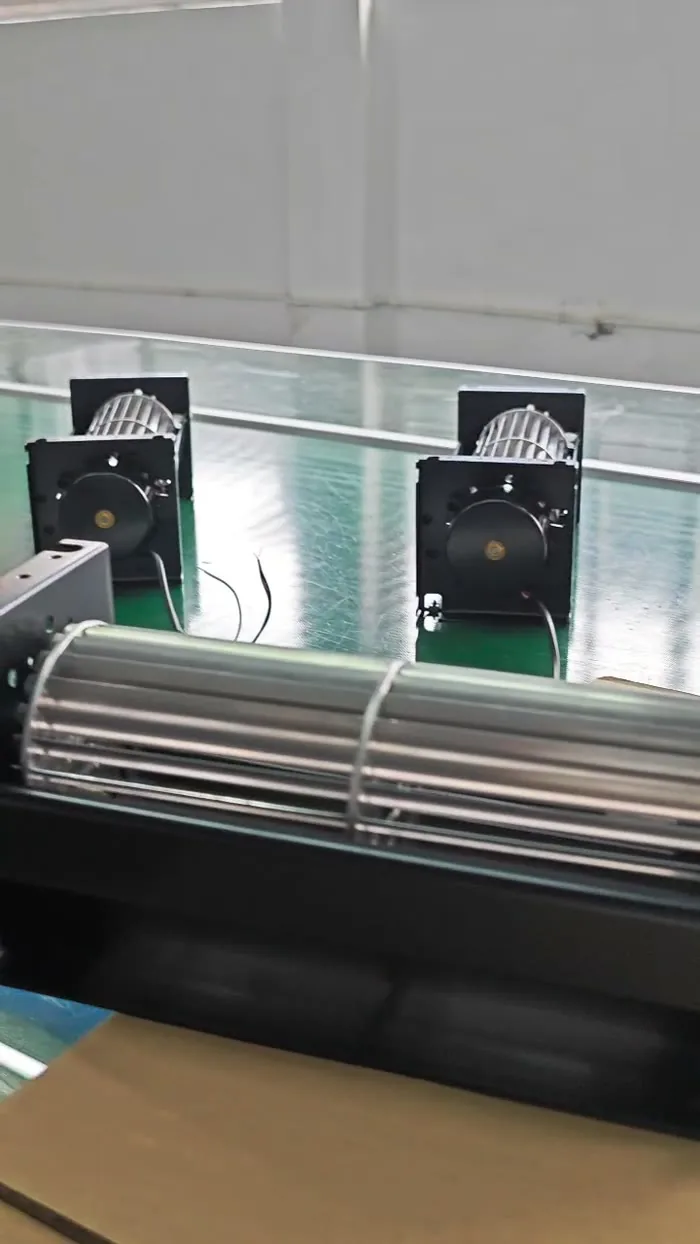
This line most often explains a large gap between two quotations. A catalogue wheel in a lightly modified housing carries no tooling. A new wheel width, volute or moulded part needs a tool — designed in 3D, checked for flow, machined by CNC and EDM, trialled, sampled and inspected against the drawing before the first production piece exists. Cross-flow fans are built in our own plant on our own drawings, moulds and impeller tooling; for the other families tooling is cut to LONGWELL drawings in qualified partner plants and inspected to LONGWELL standards.
Insist on two things when tooling appears: tooling cost and piece price quoted together, so the break-even quantity is visible, and ownership written down. Ask first whether an existing wheel and housing can hit your duty point — if nothing fits, you should hear that before the tooling line arrives. The project steps are under the OEM process.
Airflow, static pressure, voltage and control mode are enough for a first answer.
Annual volume and packing quantity
State your annual volume, not your first order — a blower quoted against a trial quantity and one quoted against a year of releases are two different exercises. Packing quantity matters more than buyers expect: small blowers ship in printed export cartons with your label, larger commercial sizes in wooden crates, and the carton often sets the minimum order for a change that only touches assembly — lead wire, connector, label, packaging.
Certification scope
Certification is priced by scope, not by the word. Our KTS CE certificates — LVD KB2207084L01, EMC KB2207085E01, RoHS KB2207086R01 — cover AC forward-curved LWFA108–450 and nothing else. ETL Recognized Component control number 5022563 covers part of the EC and DC range, inside that report's model rule and power ceiling (600 W at 48 V, 500 W at 24 V, 200 W at 12 V on DC; around 1,100 W on the EC side). Management systems are ISO 9001 BMCQ0222448M, ISO 14001 BMCE0222279M and ISO 45001 BMCS0222232M, valid to 8 December 2028.
If your file needs a certificate for a model outside those scopes, that is testing to be booked: weeks and cost, so raise it at enquiry rather than at order. Air performance is tested to the AMCA 210 method and noise measured in a semi-anechoic room, calibration report SSD202500326. Catalogue IP and insulation figures are design ratings by family (IP44 to IP54); the binding value is on your approved data sheet. Detail: quality and certifications.
Lead time and freight terms
Samples of catalogue models go out in one to three days, production runs fifteen to thirty days, warranty is twelve months. A compressed lead time is not free — it buys queue position and sometimes air freight — so if the date binds, say so early and have it quoted openly.
Freight is about volume as much as weight: a Ø146 EC blower weighs about 4.5 kg and a Ø250 EC double-inlet blower 15 kg, and neither is dense. The incoterm does not change what shipping costs, only who pays and where risk passes, so compare quotations on the same term and work out container fill from the carton data.
The most expensive mistake: the wrong duty point
Everything above is visible in a quotation. Getting the duty point wrong is not, and it costs more than all of it. Start with how catalogue data is written: maximum airflow and maximum static pressure are the two ends of one curve and never occur together — free delivery gives one, a blocked outlet the other. A specification built by pairing the two maxima produces an oversized blower every time.
An oversized blower is throttled by your own system. It draws more input power than the job needs, puts that power into the airstream and bearings as heat, and it is louder, because noise rises steeply with wheel speed and outlet velocity. Bearing life is quoted L10 at a stated temperature — 20,000 h at 70 °C on LWFE3G250-138DS-02, 30,000 h at 40 °C on the direct-drive range — so a hotter installation is a shorter one. You pay for oversizing once at purchase, then again every hour it runs.
Our selection practice targets a curve margin of roughly 10–25% over the stated duty: below about 8% nothing is left for filter loading, and well above 25% you are buying a blower you will throttle. Model-level P-Q curves and CAD are at select.longwellfans.com.
What to send, and what to ask for
| Quotation line | What moves it | What to ask for |
|---|---|---|
| Impeller | Diameter, width, material, balance grade | Drawing number and balance grade |
| Motor | Shaded pole, PSC or BLDC/EC; voltage; control input | Input power at your duty point, not rated power |
| Housing | Material, finish, outlet angle, brackets | Whether the housing is catalogue or modified |
| Tooling | New wheel, volute or moulded part | Tooling and piece price together, plus ownership |
| Volume and packing | Annual quantity, carton or crate | Carton dimensions and pieces per carton |
| Certification | Which certificate, which model scope | Certificate number and the model range it names |
| Delivery | Sample date, lead time, incoterm | All quotations on the same incoterm |
Send the duty point — airflow, static pressure, voltage, control mode, envelope, noise limit, annual volume — and we will come back with a model, a P-Q curve and a quotation broken down the way this page describes: contact LONGWELL.
Questions buyers ask
Why will you not publish a price or a price range for a centrifugal blower?
Because a blower price only exists against a specification. The same Ø250 volute blower can be an AC capacitor-run build in a galvanised housing or an EC build with a drive board, a modified wheel width and its own tooling - and those are different products with different costs. A published range would be right for nobody and would tell you nothing about the quotation in front of you. Send the duty point and annual volume and you get a real number against a real model.
Which is the biggest single cost driver in a blower quotation?
The motor, in most builds, followed by impeller diameter and material. Motor choice also carries the certification and control consequences: an EC build brings a drive board, a 0-10 V or PWM input, FG feedback and protection functions, and it sits under a different certificate scope than the AC forward-curved range.
When does a new tool make sense instead of a catalogue part?
When no existing wheel width or housing reaches your duty point or fits your envelope, and when the annual volume covers the break-even. We check the catalogue first because a catalogue wheel in a lightly modified housing is faster and cheaper. If a tool is needed, ask for the tooling cost and the piece price in the same quotation, plus a written statement of who owns the tool.
Does a higher annual volume change what you quote?
Yes, and it is worth stating the annual figure up front rather than only the first order. Volume changes batch sizes, the packing standard and the case for tooling. Packing quantity matters too: for a change that only touches assembly - lead wire, connector, label, carton - the carton is often what sets the practical minimum order.
How much does certification add?
It depends entirely on scope. Where your model already sits inside an existing scope, nothing is added: our KTS CE certificates cover AC forward-curved LWFA108-450, and ETL Recognized Component control 5022563 covers part of the EC and DC range inside that report's model rule and power ceiling. A model outside those scopes means testing has to be arranged and booked, which adds weeks as well as cost, so raise it at enquiry rather than at order.
What does an oversized blower actually cost me?
More than the purchase difference. Throttled by your own system it draws more input power than the job needs, puts that power into the airstream and bearings as heat, and runs louder because noise rises steeply with wheel speed. Bearing life is quoted L10 at a stated temperature - 20,000 h at 70 degC on LWFE3G250-138DS-02, 30,000 h at 40 degC on the direct-drive range - so a hotter installation is a shorter one. We size to a curve margin of roughly 10-25% over the stated duty for that reason.
More in this section
China Blower Supplier Audit: A Checklist from Inside the Factory
The documents to demand, how to verify a certificate number, what to look at on the floor, and the questions that expose a trading company.
Read the pageHow to Specify a Centrifugal Blower
What to tell a blower supplier to get the right model first time: duty point, voltage, control mode, envelope, noise, IP, life and volume.
Read the pageTypes of Blower Impeller: Wheel Forms, Blade Geometry and Balancing
Forward-curved, backward-curved and radial wheels compared: blade form, width, materials and balancing grades, and what each does to the curve.
Read the pageSend the duty point, get the model
Airflow, static pressure, voltage and control mode are enough to start — a drawing is better. An engineer answers, usually within one working day (GMT+8). Samples of catalogue models ship in 1–3 days.