
Centrifugal blower range
DC Brushless Blowers: DC Blower Fan and BLDC Blower Manufacturer
LONGWELL supplies DC blower fans to OEMs who need static pressure from a small package, with the speed under their own control: micro radial blower fans on a 40 mm frame up to housed DC centrifugal fans on a Ø197 mm wheel, in 12, 24 and 48 V DC and on a 310 VDC bus.
Where a DC blower fan earns its place
A DC blower fan — brushless DC blower, BLDC blower, radial blower fan — runs an electronically commutated motor, not a shaded-pole or capacitor-run AC motor. Three things follow.
- Speed is an input, not a fixed value. The housed range is built around a 0–10 V input; PWM is the alternative on small frames.
- Part-load energy. Where the duty varies, expect about 30% lower consumption at part load, confirmed against the load profile. At one fixed duty point a DC build buys control, not a smaller bill.
- It runs off the supply you have. 12, 24 and 48 V for battery, PV and telecom gear; 310 VDC where the machine already rectifies mains to a DC bus.
The range: 40 mm micro frames to Ø197 mm housed blowers
Housed DC centrifugal fans, Ø120–197 mm
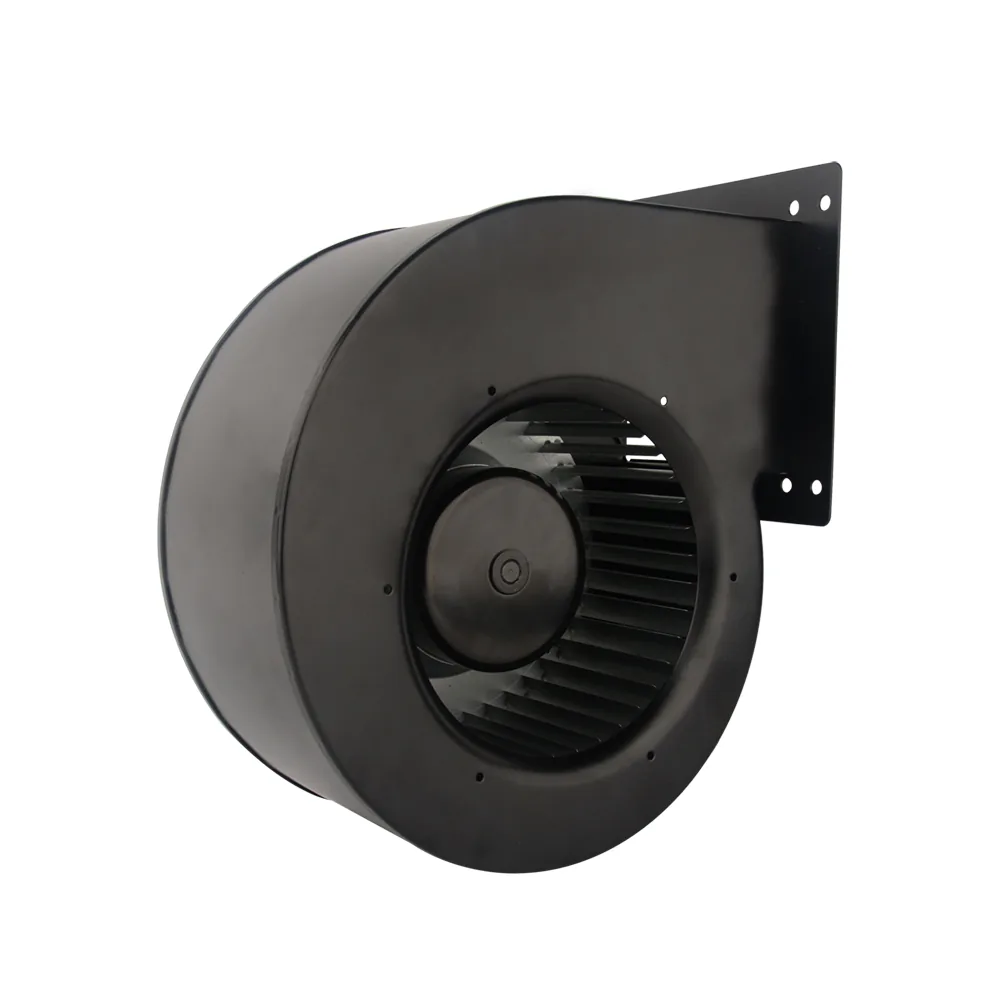
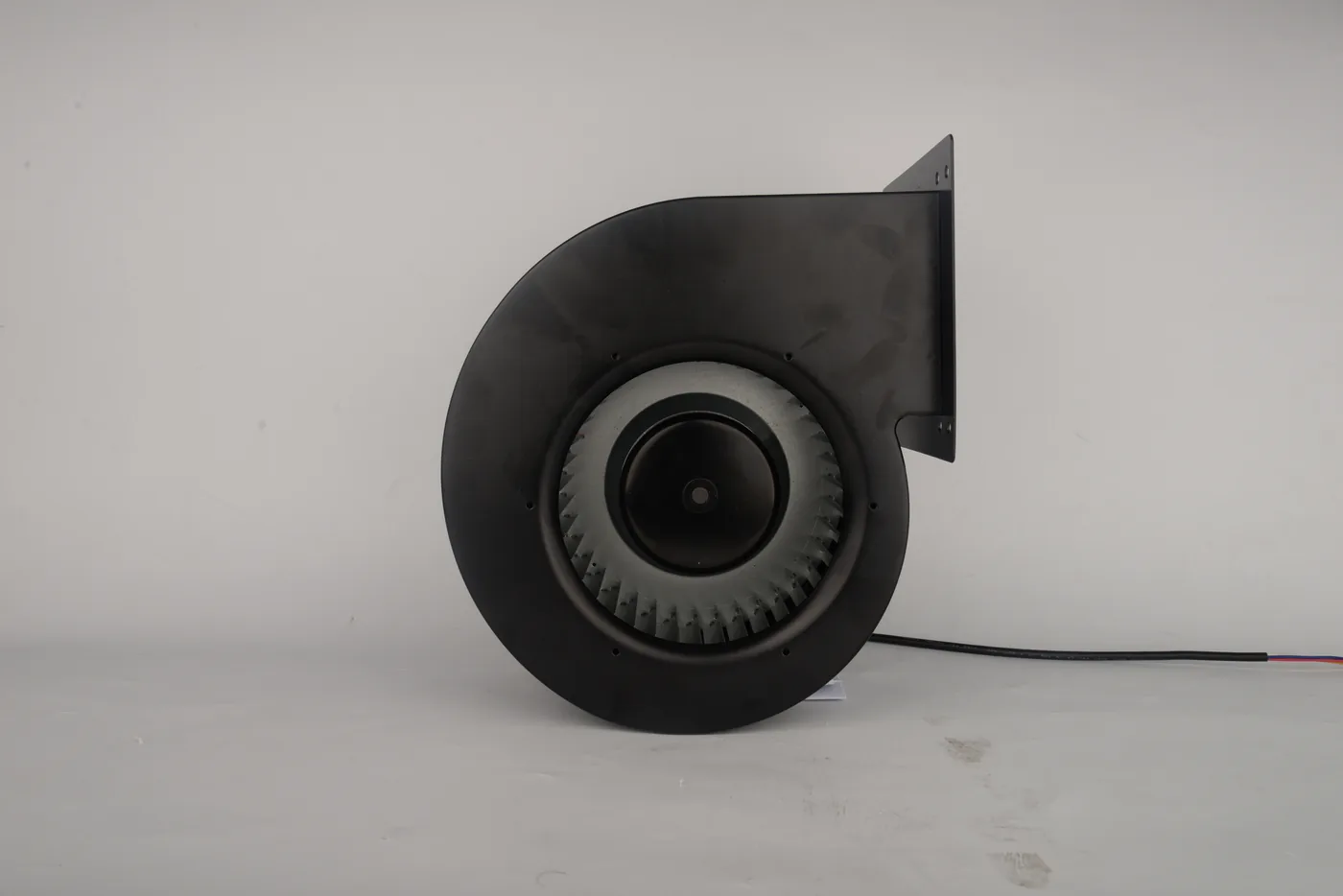
Built for equipment, not electronics: forward-curved, external-rotor DC centrifugal fans in a scroll housing, one inlet or two, DC supply and a speed signal. The single-inlet catalogue lists 28 models, LWFD3G120–180; the two-inlet catalogue 16, on Ø133–197 wheels.
| Range | Models | Wheel | Supply | Power | Speed | Airflow | Static pressure |
|---|---|---|---|---|---|---|---|
| DC forward-curved, single inlet, with housing | 28 (LWFD3G120–180) | Ø120–180 mm | 24 / 48 / 310 VDC | 48–220 W | 1,250–2,550 rpm | 319–762 m³/h | 189–773 Pa |
| DC forward-curved, two inlets, with housing | 16 (LWFD3G133 / 146 / 197) | Ø133–197 mm | 24 and 310 VDC | 80–185 W | 750–1,780 rpm | 680–1,236 m³/h | 294–597 Pa |
| Micro / mini radial blower, moulded housing | 40–120 mm frames | Per the individual model's spec sheet — example below | |||||
Catalogue data from the LONGWELL 2026 DC forward-curved blower catalogues. These are range limits: maximum airflow and maximum static pressure are opposite ends of one curve and never happen together. Worked example, LWFD3G150-092SZ-01: 310 VDC, 170 W at 2,550 rpm, up to 597 m³/h free-blowing, up to 773 Pa at shut-off. Voltage letters: L 12, M 24, H 48, Z 310 VDC — full decoder on the centrifugal blower hub. Selection is settled against your duty point — airflow, static pressure, supply voltage, control mode — then proven on your own unit before the drawing is frozen.
Micro and mini DC radial blowers, 40–120 mm frames
Small moulded-housing radial blower fans, 40 to 120 mm frames: the plastic blower fan or centrifugal cooling fan most buyers mean. This sub-family is sourced and we say so: specified by LONGWELL, built to a LONGWELL-agreed specification in a qualified partner plant, inspected to LONGWELL standards, quoted from the model's own spec sheet rather than a catalogue table. Our technical department's released spec is the LWFD6025LM-01: 12 VDC, 0.25 A, 3,200 rpm, maximum airflow 6.1 CFM, maximum static pressure 10.86 mmH2O (opposite ends of one curve), 34 dBA, flame-rated V-0 PBT housing (UL94 V-0 material grade), two ball bearings, 4-wire lead-out.
Speed control, tacho and alarm signals
Tell us the control mode first: it decides the drive, not the wire.
- 0–10 V analogue — the standard speed input across the housed DC range.
- PWM — on the small frames and the brushless forward-curved drives, whose sheets specify 1–10 kHz.
- Tacho (FG) output — a speed pulse, so your board sees the blower turning. One forward-curved drive sheet gives 12 pulses per revolution, but the count differs by drive.
- RS485 — on the 102, 138 and 188 rotors only, which makes it a size decision before a protocol one.
- Alarm or fault output — not standard on every model; ask for it at drawing stage.
Bearings, life and ingress protection
Specify ball bearings for anything that runs long hours, sits in a warm cabinet or is mounted other than horizontally: a sleeve bearing is cheaper and quiet when new, but its life falls away with ambient temperature and shaft angle. Ask for L10 life with the temperature attached: a figure at 40 °C is not comparable with one at 70 °C.
Catalogue IP and insulation values are design ratings by family: the housed DC range is catalogued IP54, most models class B. That is a design value, not a certification — what governs is the approved datasheet for your model, and we hold no third-party IP certificate here.
Airflow, static pressure, voltage and control mode are enough for a first answer.
What these DC blowers are used for
Cabinet, telecom and power-electronics cooling is the core of it: a panel blower or server blower fan pushes air through a filter and a dense heat sink, the static-pressure job where a radial fan blower beats an axial fan of the same size. The 48 V models suit telecom racks on a battery bus and 310 VDC suits inverters, UPS and drive cabinets; the housed models also go into air purifiers and fan-coil units.
A medical blower is a separate conversation: low noise, documented bearing life, a tacho output so a stall can be detected, no silent change to an approved build. We hold no medical-device certification of our own, so say early which standard your device is assessed against.
Curves, spec sheets and CAD
Model-level P-Q curves, spec sheets and 3D files sit on our selection site, select.longwellfans.com. Air performance is tested to the AMCA 210 method; sound is measured in a semi-anechoic room (calibration report SSD202500326).
Who engineers it, who builds it
Ningbo Longwell Electric Technology Co., Ltd. has been in HVAC air movement since 1990, from Yuyao, Ningbo, exports to 30+ countries and works as an OEM blower factory. On the housed Ø120–197 mm DC range that is concrete: LONGWELL owns those drawings, so outlet orientation, inlet ring, bracket and lead-out are drawing changes, a new volute width a tooling change. These blowers are built to LONGWELL drawings by qualified partner plants, inspected to LONGWELL standards — full sourcing statement on the home page, motor winding line on the factory page.
Certificate scope in one line: LONGWELL holds ETL Recognized Component status under Intertek control number 5022563, covering part of the EC and DC forward-curved range inside the report's model rule (DC: up to 600 W at 48 V, 500 W at 24 V, 200 W at 12 V), confirmed per model in writing before we quote; the KTS CE certificates cover the AC forward-curved LWFA108–450 range, not this one. See quality and certifications.
Samples, changes and lead time
Samples of catalogue models ship in 1–3 days, production runs 15–30 days, warranty is 12 months. Changing an outlet angle, lead, connector, inlet ring or bracket is a drawing and tooling question: send it and you get cost, tooling position and sample date in one reply. Related ranges: forward-curved squirrel cage blowers, single inlet centrifugal blowers, gas and combustion blowers, the centrifugal blower hub, and blower wheels and housings.
Frequently asked questions
What is the difference between your DC blower and your EC blower?
The input. D is DC — 12, 24 or 48 V DC, or a 310 VDC bus. E is EC — mains AC, rectified inside the drive. Both are brushless and take a speed signal. If your machine has a DC rail, use a DC blower; with a mains cord, an EC blower saves you the supply.
Which control input should I specify — 0–10 V, PWM, tacho or RS485?
The simplest one your board already produces. 0–10 V is the default on the housed range, PWM suits the small frames, and a tacho pulse is one extra wire worth having whenever a stall must be detected. RS485 exists only on the larger rotors, so ask before the frame is fixed.
Can you change the housing, outlet and lead-out on a DC blower?
On the Ø120–197 mm forward-curved DC range, yes — LONGWELL owns those drawings, so housing, outlet orientation, inlet, bracket, lead-out, connector and label are open. Send a 2D or 3D file with the duty point and control mode and we will say what is a parts change and what needs tooling; the route to first article is in the OEM process.
Can a DC blower replace the AC blower we use now?
Rarely as a straight drop-in: the supply changes, usually the mounting with it, and the machine has to provide the speed signal the drive expects. What transfers is the duty point — send the airflow and static pressure the AC unit actually delivers, plus its envelope, and we match those first.
Request a quote
Send airflow and static pressure at each end of your working range, the supply, control input, envelope and annual quantity — plus any drawing. We reply quickly, usually the next working day, with the models that fit, their curves and the cost of any change. Request a quote.
Questions buyers ask
What is the difference between your DC blower and your EC blower?
The input. D is DC — 12, 24 or 48 V DC, or a 310 VDC bus. E is EC — mains AC, rectified inside the drive. Both are brushless and take a speed signal. If your machine has a DC rail, use a DC blower; with a mains cord, an EC blower saves you the supply.
Which control input should I specify — 0–10 V, PWM, tacho or RS485?
The simplest one your board already produces. 0–10 V is the default on the housed range, PWM suits the small frames, and a tacho pulse is one extra wire worth having whenever a stall must be detected. RS485 exists only on the larger rotors, so ask before the frame is fixed.
Can you change the housing, outlet and lead-out on a DC blower?
On the Ø120–197 mm forward-curved DC range, yes — LONGWELL owns those drawings, so housing, outlet orientation, inlet, bracket, lead-out, connector and label are open. Send a 2D or 3D file with the duty point and control mode and we will say what is a parts change and what needs tooling; the route to first article is in the OEM process on the home page.
Can a DC blower replace the AC blower we use now?
Rarely as a straight drop-in: the supply changes, usually the mounting with it, and the machine has to provide the speed signal the drive expects. What transfers is the duty point — send the airflow and static pressure the AC unit actually delivers, plus its envelope, and we match those first.
More in this section
Combustion Blowers for Gas Boilers, Water Heaters and Premix Burners
AC, EC and DC combustion blowers for gas boilers, water heaters and premix burners: 82-260 m3/h, to 4,100 Pa, 30-300 W, built to LONGWELL drawings.
Read the pageEC Centrifugal Blowers
LONGWELL LWFE3G EC centrifugal blowers: 51 models, 42-2400 W, to 8799 m3/h and 1102 Pa, 0-10 V, PWM and RS485 control. OEM supply, samples in 1-3 days.
Read the pageForward Curved Squirrel Cage Blowers — AC, EC and DC, Ø108–500 mm
AC, EC and DC squirrel cage blowers, Ø108–500 mm, to 9,064 m³/h. Catalogue data, model code, and CE and ETL scope stated plainly.
Read the pageSingle Inlet Centrifugal Blowers — OEM Manufacturer in China
Single inlet centrifugal blowers Ø120–315 mm in AC, DC and EC: 206–5,150 m³/h, up to 989 Pa, built to LONGWELL drawings. Samples in 1–3 days.
Read the pageSend the duty point, get the model
Airflow, static pressure, voltage and control mode are enough to start — a drawing is better. An engineer answers, usually within one working day (GMT+8). Samples of catalogue models ship in 1–3 days.