
Home/Blowers/Forward Curved & Squirrel Cage
Centrifugal blower range
Forward Curved Squirrel Cage Blowers — AC, EC and DC, Ø108–500 mm
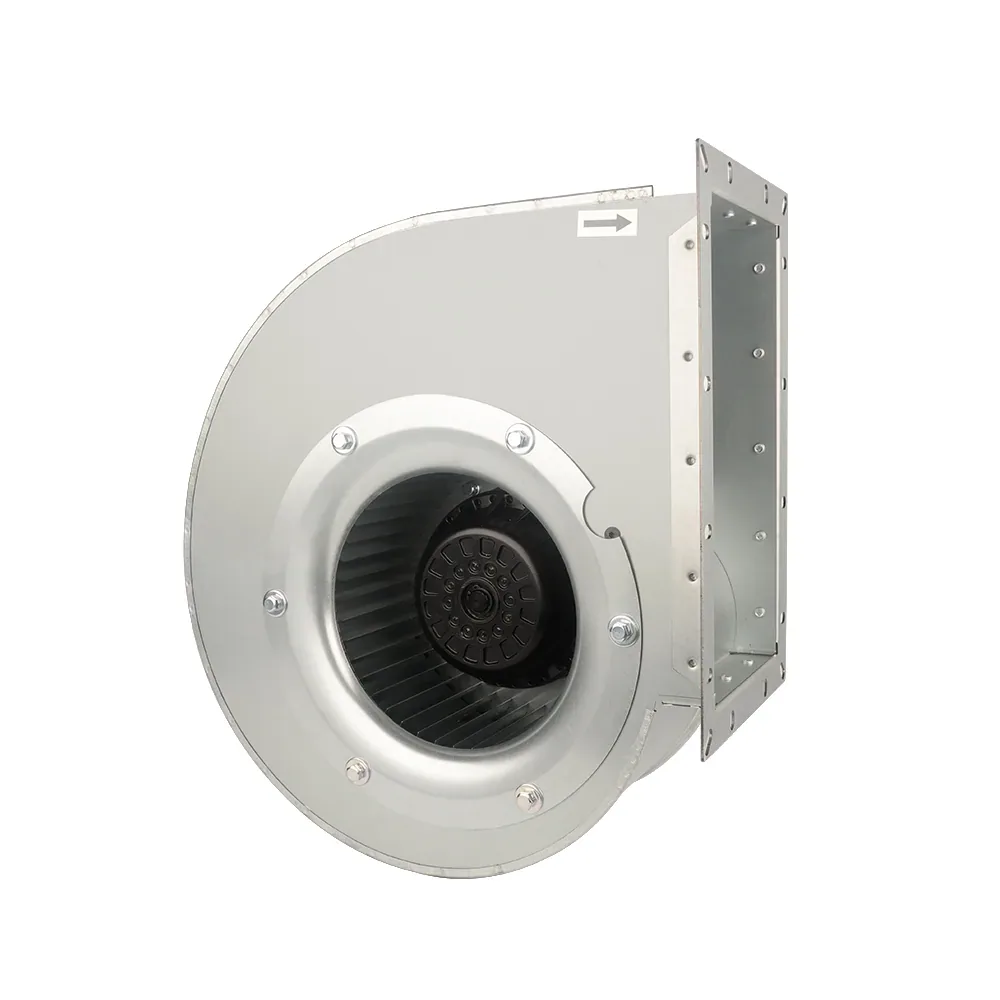
A squirrel cage blower is a centrifugal blower with a forward curved wheel — a drum of short blades leaning into the rotation, inside a scroll housing. It is also sold as a snail blower, a scroll blower or a forward curved blower. For its diameter and speed it moves more air than any other centrifugal type, which is why it sits inside most compact HVAC, heating and appliance units.
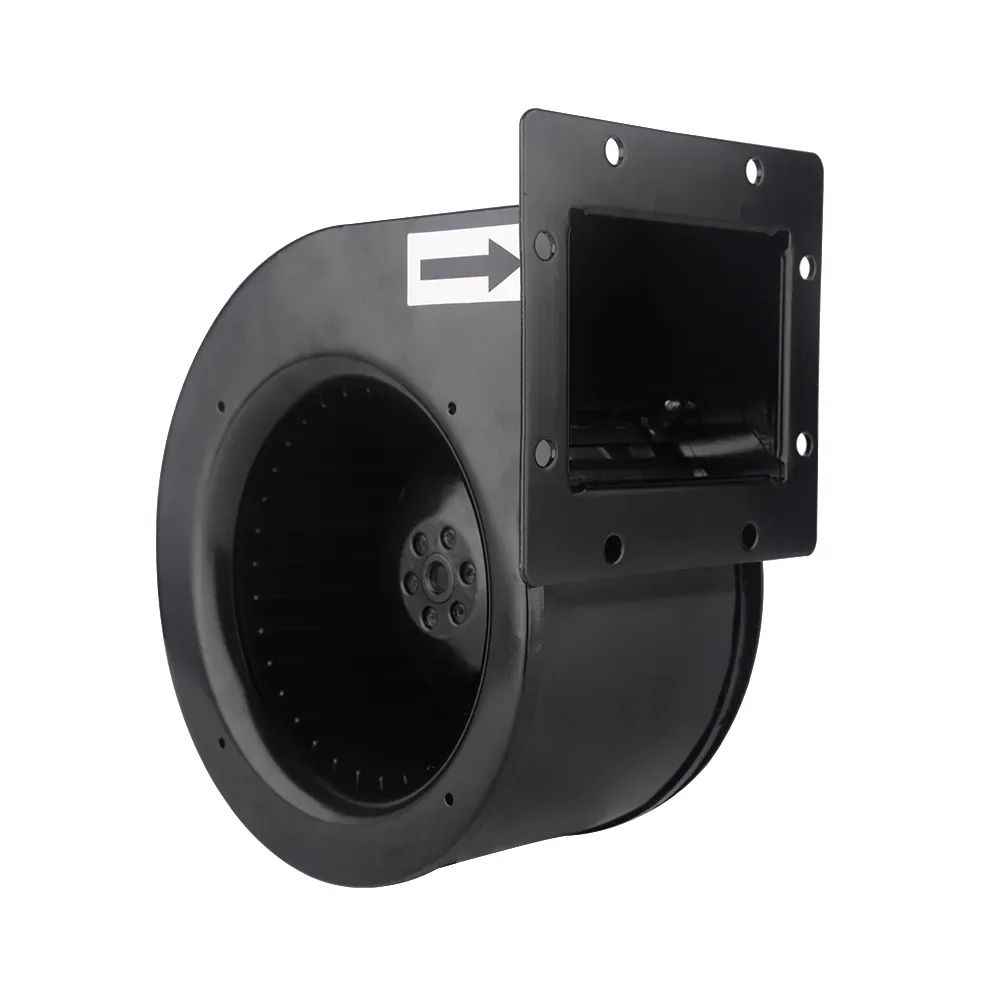
LONGWELL (Ningbo Longwell Electric Technology Co., Ltd., Yuyao, Ningbo, founded 1990) covers this family in AC, EC and DC across 17 standard sizes, Ø108 to Ø500 mm, so a small squirrel cage blower here starts at 108 mm. One line on how it is made, because that changes how you audit us: LONGWELL draws and specifies this range, has it built to those drawings and inspects it to LONGWELL standards — full statement on our China centrifugal blower manufacturer home page, rest of the scroll family on the centrifugal blowers hub.
How a forward curved wheel behaves
- High airflow at low to medium pressure. A 146 mm EC wheel on 115 W at 1,450 rpm reaches about 1,009 m³/h free blowing and about 670 Pa at shut-off — two ends of one curve, not one duty point.
- A flat curve. A dirtier filter, a tighter coil or a longer duct moves airflow a long way, so select at the resistance you have, not at free air.
- A steep power curve. Shaft power climbs with airflow, so the motor draws its highest current at the lowest resistance — size for that case or it overloads in free air.
Speed is the practical control: the three-tap AC model LWFA2E133-092SS-03 runs 1,600 / 1,100 / 800 rpm on 230 VAC, reaching up to 319 / 206 / 146 m³/h free blowing and up to 433 / 350 / 288 Pa at shut-off; EC and DC do the same steplessly on 0–10 V or PWM. Higher up the pressure range a backward curved or plug wheel is the better machine — that range is on our main site, longwellfans.com.
Builds and model code
Four construction letters cover the family: N an open wheel for OEMs whose own sheet metal forms the scroll, S the narrow housed build with one mounting face (the single inlet blower page says when to pick it), D a longer wheel fed from both ends that moves far more air at the same diameter and speed, P with bracket. Drawings, curves and CAD per model: select.longwellfans.com.
The number itself is LW + F/B (forward or backward curved) + A/D/E (AC, DC, EC) + poles or phases + wheel diameter + rotor size + construction letter + voltage letter + serial. LWFE3G250-138DS-02 is EC, 250 mm wheel, 138 rotor, two inlets with housing, letter S for the nominal 230 V class — its datasheet and nameplate read 220 VAC.
- Poles or phases: 2E / 4E / 6E single-phase AC, 4D / 6D / 8D three-phase AC, 3G on EC and DC.
- Rotor sizes: 072, 092, 102, 138, 188, 218. RS485 on the 102, 138 and 188 rotors only.
- Voltage: T 380 VAC, S 230 VAC, U 115 V, L 12 VDC, M 24 VDC, H 48 VDC, Z 310 VDC.
Catalogue range
| Range | Models | Wheel Ø (mm) | Supply | Power | Airflow | Static pressure | Speed |
|---|---|---|---|---|---|---|---|
| LWFA AC, no housing | 38 | 108–500 | 220 / 230 / 380 V | 50–4,800 W | 206–9,064 m³/h | 155–1,030 Pa | 680–2,850 rpm |
| LWFA AC, single inlet | 24 | 120–315 | 230 / 380 V | 54–2,200 W | 206–5,150 m³/h | 201–695 Pa | per model datasheet |
| LWFA AC, double inlet | 33 | 120–300 | 230 V single phase | 60–1,380 W | 278–5,227 m³/h | 134–639 Pa | per model datasheet |
| LWFE3G EC, no housing | 8 | 108–160 | 230 V | 70–230 W | 330–803 m³/h | 216–989 Pa | 1,800–3,340 rpm |
| LWFE3G EC, single inlet | 21 | 120–250 | per model datasheet | 42–510 W | 268–1,957 m³/h | 191–989 Pa | 1,320–3,650 rpm |
| LWFE3G EC, double inlet | 22 | 120–355 | 230 / 380 V | 70–2,400 W | 433–8,799 m³/h | 247–1,102 Pa | 760–3,200 rpm |
| LWFD3G DC, single inlet | 28 | 120–180 | 24 / 48 / 310 V DC | 48–220 W | 319–762 m³/h | 189–773 Pa | 1,250–2,550 rpm |
| LWFD3G DC, double inlet | 16 | 133 / 146 / 197 | 24 and 310 V DC | 80–185 W | 680–1,236 m³/h | 294–597 Pa | 750–1,780 rpm |
Worked AC and EC examples below; the DC ones are on the DC blower page.
| Model | Type | Supply | Input | Speed | Max airflow | Max static pressure | Noise |
|---|---|---|---|---|---|---|---|
| LWFA2E133-092SS-03 | AC single inlet, 3 speed | 230 V (198–242) | 2 µF | 1,600 / 1,100 / 800 rpm | 319 / 206 / 146 m³/h | 433 / 350 / 288 Pa | — |
| LWFA2E120-092DS-01 | AC double inlet | 230 V single phase | 65 W | 1,300 rpm | 299 m³/h | 278 Pa | 54 dB(A) |
| LWFE3G160-072NS-01 | EC, no housing | 230 V | 115 W | 1,800 rpm | 639 m³/h | 906 Pa | — |
| LWFE3G146-092DS-02 | EC double inlet | 230 V (200–277) | 115 W / 0.8 A | 1,450 rpm | 1,009 m³/h | 670 Pa | 61 dB(A) |
| LWFE3G250-138DS-02 | EC double inlet | 220 V | 750 W / 3.5 A | 960 rpm | 4,017 m³/h | 479 Pa | 75 dB(A) |
Catalogue and datasheet figures, 2026 LONGWELL forward curved blower catalogues. Maximum airflow and maximum static pressure are the two ends of one curve and never occur together. Before anything is tooled or shipped we confirm the model against your duty point — airflow, static pressure, voltage, control mode — and validate it on your unit.
Airflow, static pressure, voltage and control mode are enough for a first answer.
Evaporator and cold room blowers
An evaporator or condenser block gives the blower a coil to push through and little room to do it in — the forward curved working range. Heat pump and cold room duties sit in the same band, and the AC open-wheel range is rated -30 to +60 °C ambient in the catalogue. Pick the duty frosted and dirty, then check motor current clean. Galvanized housings suit condensate and washdown; plastic volutes are supplied on AC frames.
Fan coil unit blowers
An FCU blower is nearly always a wide, twin-fed forward curved assembly, because a fan coil casing is shallow and wide. The standard builds are a three-speed AC motor with a run capacitor, or an EC motor on 0–10 V or PWM control. LWFE3G146-092DS-02 is the typical fan coil blower motor: 115 W at 1,450 rpm, 61 dB(A), about 4.5 kg, G6.3, 20,000 h L10 bearing life. An EC motor for FCU duty gives about 30% lower consumption at part load, confirmed against the load profile, and holds airflow as the filter loads — see the EC centrifugal blower page.
Heater and convector blowers
Commercial heater blowers share one problem: hot air, and a motor close to the element. We go through the ambient at the motor, the insulation class and the thermal protector with you — on LWFA2E133-092SS-03 it opens at 150–160 °C. Steel scrolls and metal wheels are standard for industrial electric heaters, and a flat curve lets one blower serve several heat convector outputs on a different tap.
How these blowers are specified and checked
LONGWELL owns the drawings for this range, which decides what a change costs you: volute width, outlet angle, inlet ring, bracket, lead-out, connector, speed taps and nameplate are drawing changes with no tooling; a new wheel width or a moulded scroll is tooled and quoted separately. The OEM process section covers sample to first lot; the company’s own motor winding line in Yuyao, audited in the 2021 ETL factory audit, is described on the factory page.
- Certificate scope, stated plainly. The KTS CE certificates (LVD, EMC, RoHS) cover the AC forward curved LWFA 108–450 range only: Ø500 is outside them, and they do not extend to LWFE3G or LWFD3G. Part of the EC and DC range is an ETL Recognized Component under control number 5022563, inside that report's model rule and power ceiling — around 1,100 W on the EC side, so the largest EC double inlet builds above fall outside it. We confirm coverage per model in writing rather than send a document that does not cover it. Quality and certifications has the numbers and validity dates.
- Test. Air performance is tested to the AMCA 210 method — the method, not an AMCA certification — and sound in a semi-anechoic room, calibration report SSD202500326. EC builds above are balanced to G6.3.
- Ratings. Catalogue IP and insulation values are design ratings by family, not third-party certifications, and a model's approved datasheet can differ from the catalogue. We confirm both per model and hold no third-party IP certificate.
Neighbouring lines: single inlet centrifugal blowers, DC brushless blowers, gas and combustion blowers, blower wheels and impellers, and the centrifugal blowers hub.
FAQ
Is a squirrel cage blower the same as a forward curved centrifugal blower?
Yes. "Forward curved" names the blades, "squirrel cage" the wheel, "snail" and "scroll" the housing. One machine, four names.
Why does the motor draw the most current with nothing connected to it?
It has a rising power curve: the less resistance the wheel sees, the more air it moves and the more shaft power it needs. Free air — ducting off, filter out, bench test — is the worst case for the motor, not the easiest.
AC, EC or DC on a forward curved blower?
What differs here is how speed changes. AC gives two or three fixed taps and a capacitor: cheapest to buy and wire, fine when the unit's resistance does not move much. EC and DC take a stepless 0–10 V or PWM input, so the blower holds airflow as the filter loads instead of sliding down its curve. The wider motor comparison is on the centrifugal blowers hub.
What can you change without tooling?
Outlet angle, mounting feet and bracket, shaft or hub, lead length, connector, speed taps, wire colours and the nameplate. A different wheel width, a new scroll or a moulded housing needs tooling, quoted separately and flagged before you commit to it.
To get a model back, send airflow and static pressure at the duty point, supply and control mode, envelope and outlet direction, any noise limit and the annual quantity — or a photo of the nameplate you are replacing. Samples of catalogue models ship in 1–3 days, production 15–30 days, warranty 12 months, and we export to 30+ countries. Request a quote; we reply quickly, usually the next working day, with the models that match and the cost of any tooled change.
Questions buyers ask
Is a squirrel cage blower the same as a forward curved centrifugal blower?
Yes. "Forward curved" names the blades, "squirrel cage" the wheel, "snail" and "scroll" the housing. One machine, four names.
Why does the motor draw the most current with nothing connected to it?
It has a rising power curve: the less resistance the wheel sees, the more air it moves and the more shaft power it needs. Free air — ducting off, filter out, bench test — is the worst case for the motor, not the easiest.
AC, EC or DC on a forward curved blower?
What differs here is how speed changes. AC gives two or three fixed taps and a capacitor: cheapest to buy and wire, fine when the unit's resistance does not move much. EC and DC take a stepless 0–10 V or PWM input, so the blower holds airflow as the filter loads instead of sliding down its curve. The wider motor comparison is on the centrifugal blowers hub.
What can you change without tooling?
Outlet angle, mounting feet and bracket, shaft or hub, lead length, connector, speed taps, wire colours and the nameplate. A different wheel width, a new scroll or a moulded housing needs tooling, quoted separately and flagged before you commit to it.
More in this section
Combustion Blowers for Gas Boilers, Water Heaters and Premix Burners
AC, EC and DC combustion blowers for gas boilers, water heaters and premix burners: 82-260 m3/h, to 4,100 Pa, 30-300 W, built to LONGWELL drawings.
Read the pageDC Brushless Blowers: DC Blower Fan and BLDC Blower Manufacturer
DC blower fans 40-197 mm, 12/24/48 V and 310 VDC, PWM or 0-10 V, ball bearings. Built to LONGWELL drawings. Curves and CAD on our selection site.
Read the pageEC Centrifugal Blowers
LONGWELL LWFE3G EC centrifugal blowers: 51 models, 42-2400 W, to 8799 m3/h and 1102 Pa, 0-10 V, PWM and RS485 control. OEM supply, samples in 1-3 days.
Read the pageSingle Inlet Centrifugal Blowers — OEM Manufacturer in China
Single inlet centrifugal blowers Ø120–315 mm in AC, DC and EC: 206–5,150 m³/h, up to 989 Pa, built to LONGWELL drawings. Samples in 1–3 days.
Read the pageSend the duty point, get the model
Airflow, static pressure, voltage and control mode are enough to start — a drawing is better. An engineer answers, usually within one working day (GMT+8). Samples of catalogue models ship in 1–3 days.