
Buyer guide
How to Specify a Centrifugal Blower
An enquiry with ten lines filled in gets back a model number, a curve with your operating point marked on it and a sample date. One that says “I need a blower, around 500 CFM” gets four questions back, and a week goes past. This page is for OEMs and equipment builders: what a blower supplier needs from you, and how to work out the two numbers that matter most when nobody has given you a system curve.
Everything starts at the duty point
A duty point is two numbers that belong together: the airflow you need, and the static pressure the blower has to produce at that airflow. Airflow alone is not a duty point. Pressure alone is not a duty point. And the two are never multiplied into a third number sent instead.
The reason sits in how catalogue figures are produced. Maximum airflow is measured at zero static pressure, with nothing in the way; maximum static pressure is measured at zero airflow, with the outlet blanked. They are the two ends of one curve and never occur together. On one of our 146 mm EC double inlet blowers — 230 V, 115 W, 1,450 rpm — the curve at a 10 V control input runs from about 670 Pa at the blanked end to about 1,009 m³/h at the open end. Yours sits on the line between them.
Multiplying the two is a separate trap. Airflow × pressure is air power, worth sixty seconds as a sanity check: 1,000 m³/h at 400 Pa is 1,000 ÷ 3,600 × 400 = 111 W, and no blower reaches that point on less input power. A datasheet claiming otherwise can be put down. What air power is not is a duty.
Estimating system resistance when you have no curve
Most OEMs have never measured a system curve. Resistance rises roughly with the square of airflow, so one honest pair of numbers is enough to start. Three routes that work:
- Measure the machine you already have. A static pressure reading at the blower outlet at a known airflow beats any estimated table.
- Add up the components at design flow. Filter, coil, heat exchanger, grille, silencer, duct and bends each publish a pressure drop at a stated flow. Sum them at your design airflow.
- Send us the assembly. A drawing, a STEP file or the cabinet itself; we work from the free area, the inlet approach and the outlet route.
Then state three things about the number, because each moves it further than it looks: static or total pressure; clean or dirty filter — the honest figure is the final resistance the machine still has to run at; and the air state. Catalogue and selector curves are standard air, 20 °C and 1.2 kg/m³; above roughly 1,000 m, or in hot gas, say so and the correction gets applied.
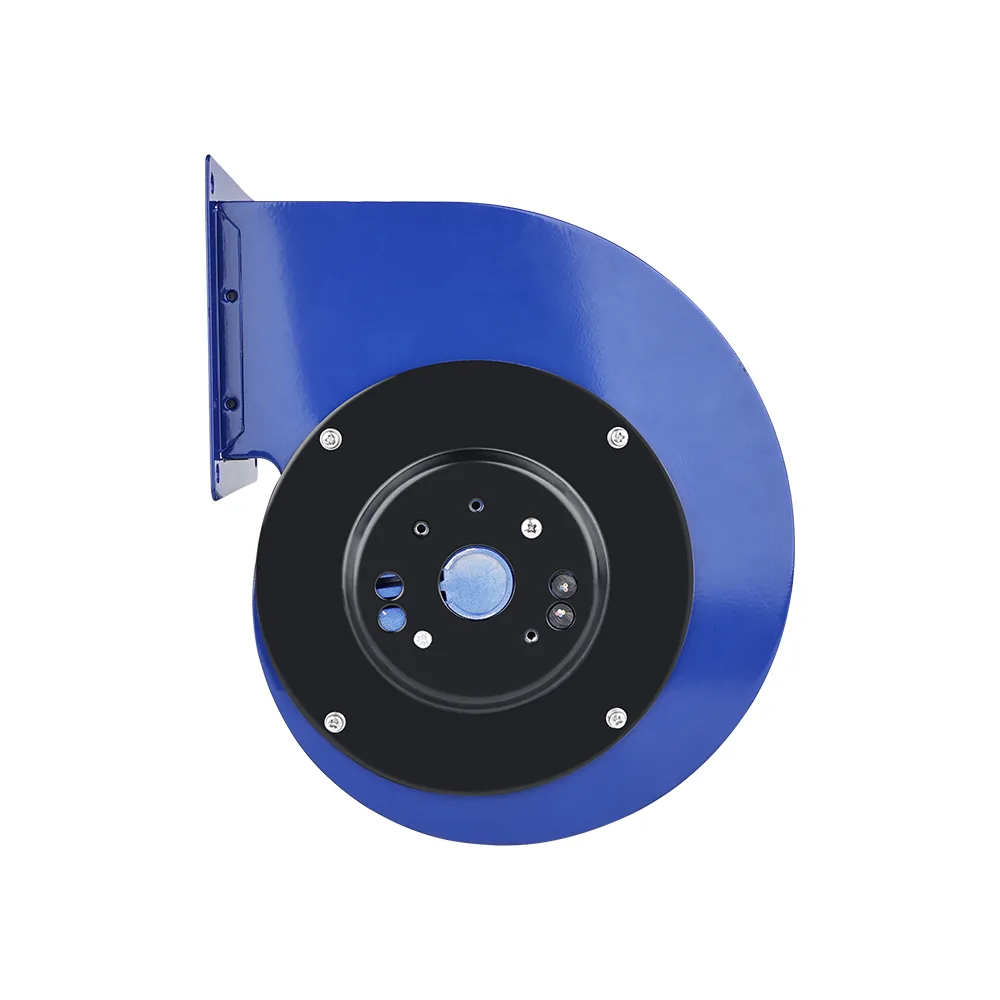
Reading a P-Q curve, and where your point should sit
A P-Q curve plots static pressure up the side against airflow along the bottom. A speed-controlled blower has a family of them: the same 146 mm EC wheel reaches about 670 Pa on a 10 V input, roughly 380 Pa at 6.5 V and roughly 160 Pa at 4.5 V. Your system curve crosses one of those lines in exactly one place, and that crossing is what the machine does in the field. Where it belongs is easiest to state as two places it does not.
- Not at free delivery, the open right-hand end. A forward-curved wheel has a rising power curve: the less resistance it sees, the more air it moves and the more shaft power it pulls. Sit out there and the motor is at maximum load every time a damper opens — the classic commissioning trip. Ask for the maximum shaft power at the lowest resistance your system can reach, and size the supply for that.
- Not at shut-off, the left-hand end. Airflow is unstable there, noise climbs, and a slightly dirtier filter drops you further into it.
- Aim for a 10–25% pressure margin at your airflow — the static pressure still left above your point. Below about 10%, a loaded filter pushes the machine into the unstable region. Above 25%, you have bought capacity you will throttle away for the life of the product; our selection tool scores a 139% margin down, not up.
Curves, drawings and CAD for individual models are on our selection site. Family range limits are on the centrifugal blower hub, and the forward-curved power curve on the forward curved squirrel cage blower page.
Airflow, static pressure, voltage and control mode are enough for a first answer.
The ten lines that decide the model
Copy this into your RFQ. Anything you do not know, write “unknown” rather than guessing: a guessed figure is worse than a blank one, because it gets designed in.
| What to send | In what form | What it changes |
|---|---|---|
| 1. Duty point | Airflow and static pressure at that airflow, with units (m³/h or CFM, Pa or in.wg) | Family and wheel size. Nothing is selectable without both. |
| 2. Resistance basis | Static or total; clean or dirty filter; air temperature and altitude | Where the point sits on the curve. The final-resistance figure is the one to meet. |
| 3. Supply | Nominal voltage and tolerance band, 50 or 60 Hz, single or three phase | The model code itself — our codes carry a voltage letter (T 380 V AC, S 230 V AC, U 115 V, M 24 V DC, H 48 V DC, Z 310 V DC). Re-rating a 380 V model to 220 V gives a different model number and its own datasheet. |
| 4. Control mode | Fixed speed, tapped speeds, 0–10 V or PWM; whether you need FG feedback or RS485 | AC, DC or EC. EC and DC drives take 0–10 V or PWM (1–10 kHz, 30–70% duty) with FG output and soft start. Where the duty varies, expect about 30% lower consumption at part load, confirmed against the load profile. |
| 5. Envelope and mounting | Maximum box, outlet orientation, the face free for intake, bracket or foot, horizontal or vertical running | Single inlet, double inlet or housingless, and whether existing tooling fits. Structure letters: N housingless, S single inlet, D double inlet, P with bracket. |
| 6. Noise limit | The dB(A) limit and its basis: sound pressure or sound power, at what distance, with how many units running | A limit with no basis can neither be met nor disputed. Datasheet LpA figures are single-unit: 61 dB(A) on the 146 mm EC, 75 dB(A) on a 250 mm EC at 750 W. |
| 7. Temperature and IP | Ambient range, humidity, altitude, indoor or outdoor, any washdown | Motor class and sealing. EC datasheets state −20 to +60 °C, 30–95% RH, below 1,000 m. IP44–IP54 are catalogue design ratings, not third-party certified. |
| 8. Life expectation | Hours, at what ambient, and the duty cycle behind them | Bearings, grease and drive rating. EC datasheets give 20,000 h L10 at 40 °C; a longer figure is a different build, not a different label. |
| 9. Annual volume | Annual quantity, first order size, call-off pattern | Catalogue model against dedicated tooling, and the MOQ quoted with it. |
| 10. Certification target | Market, the standard your appliance must meet, and who holds the file | Whether a catalogue model can carry your approval at all. Testing is booked in weeks, not days. |
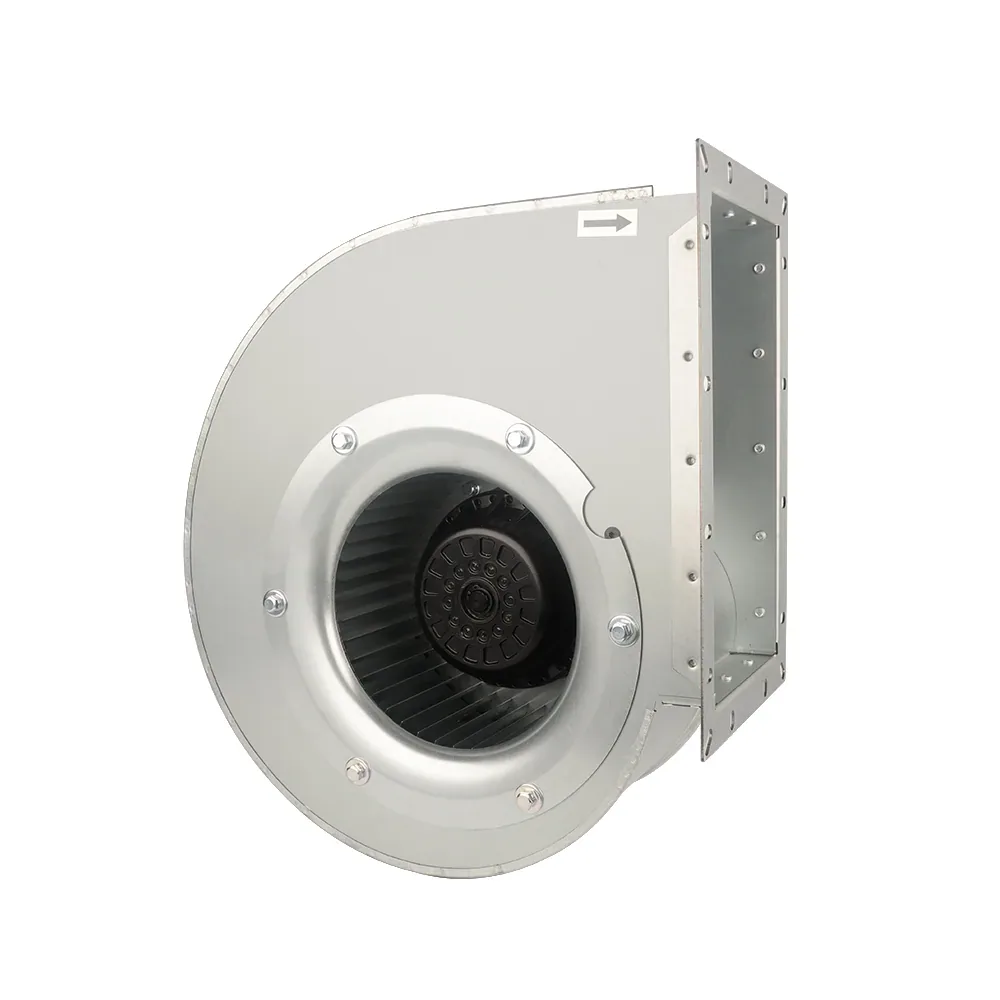
Name the certification target before the drawing is frozen
Approvals are scope-limited, and the scope is the part that matters. Our KTS CE set of 11 July 2022 — LVD KB2207084L01, EMC KB2207085E01, RoHS KB2207086R01 — covers AC forward-curved blowers LWFA108 to LWFA450 only. Part of the EC and DC range holds ETL Recognized Component status under Intertek control number 5022563, inside that report’s model rule and power ceiling (DC: 600 W at 48 V, 500 W at 24 V, 200 W at 12 V; around 1,100 W on the EC side). Air performance is tested to the AMCA 210 method, which is how the curves you receive are produced; noise is measured in a semi-anechoic room calibrated under report SSD202500326. IP figures are design ratings — we hold no third-party IP certificate. Send the exact model code and the scope is confirmed in writing; full list on the quality and certifications page.
What comes back, and how it is proved
The first reply is normally the nearest catalogue model — the fastest route to something you can fit and test — with a modified version quoted beside it. Selection is confirmed against your duty point — airflow, static pressure, supply voltage, control mode — and validated on your own unit before the drawing is frozen. Samples of catalogue models ship in 1–3 days, production runs 15–30 days, warranty is 12 months. The route from enquiry to first article is at OEM process.
Send the ten lines, or just the first one, to our engineering desk and you will have candidate models, their curves with your point marked and a sample date — usually by the next working day.
Questions buyers ask
I only know the airflow I need. Can you still quote?
We can start, but the model will not be final. Airflow alone can be met by a dozen blowers that behave completely differently once your machine puts resistance in front of them. Send the airflow plus any one honest pressure figure - a reading from an existing unit, or the sum of the filter, coil and grille pressure drops at your design flow - and the selection stops being a guess. If you have neither, send the assembly or a drawing and we will work the resistance out from the free area, the inlet approach and the outlet route.
Can I just send the nameplate of the blower I am replacing?
It is a useful starting point and it is better than nothing, but a nameplate carries voltage, power, speed and a model code - not the duty point. What transfers is the airflow and static pressure the old unit actually delivers in your machine, plus the envelope, the outlet orientation and the mounting. Send the nameplate photo with those, and the reply comes back as a fitting model rather than a similar-looking one.
Do you want static pressure or total pressure?
Static pressure, unless you say otherwise - and say which one you are sending, because the difference is real. On a centrifugal blower the inlet and outlet areas differ, so the velocity pressure does not simply cancel, and a total-pressure figure read as static will oversize the machine. State the basis once in the RFQ and the whole selection stays consistent.
How much margin should I ask for above my duty point?
Aim for 10-25% static pressure in reserve at your design airflow. Under about 10% and the machine slides into its unstable region as soon as a filter loads up. Over 25% and you have bought capacity that gets throttled away for the life of the product; our own selection tool marks a very generous margin down rather than up. If the duty varies a lot, an EC or DC drive holds the point instead of letting it drift.
Why does changing the supply voltage change the model number?
Because voltage is built into the motor, not set by a switch. Our model codes carry a voltage letter, so a 380 V three-phase model re-rated to 220 V becomes a different model with its own datasheet, its own current and its own cost basis. Tell us the nominal voltage, the tolerance band, 50 or 60 Hz and the phase count at the enquiry stage and the right code is issued from the start.
When do I need to tell you the certification target?
Before the drawing is frozen. Approvals are scope-limited: our CE set covers AC forward-curved LWFA108 to LWFA450 only, and part of the EC and DC range is an ETL Recognized Component under Intertek control number 5022563 within that report's model rule and power ceiling. If your market needs something outside those scopes, testing has to be booked, and that is measured in weeks. Send the exact model code and the market, and the scope is confirmed in writing.
More in this section
China Blower Supplier Audit: A Checklist from Inside the Factory
The documents to demand, how to verify a certificate number, what to look at on the floor, and the questions that expose a trading company.
Read the pageTypes of Blower Impeller: Wheel Forms, Blade Geometry and Balancing
Forward-curved, backward-curved and radial wheels compared: blade form, width, materials and balancing grades, and what each does to the curve.
Read the pageWhat drives the cost of an OEM centrifugal blower
No prices - what actually moves a centrifugal blower quotation: wheel size and material, motor type, tooling, volume, certification and freight.
Read the pageSend the duty point, get the model
Airflow, static pressure, voltage and control mode are enough to start — a drawing is better. An engineer answers, usually within one working day (GMT+8). Samples of catalogue models ship in 1–3 days.